For hospitals, nursing schools and emergency services

VR medical training, built around your hospital.

Custom VR medical training and AI virtual patients for nurses, paramedics and surgeons. Built on your own rooms, protocols and languages, so staff practise the rare and risky moments before they meet them on the ward.

University Hospital Bonn trains 1,600 nursing staff and students with our VR programme.

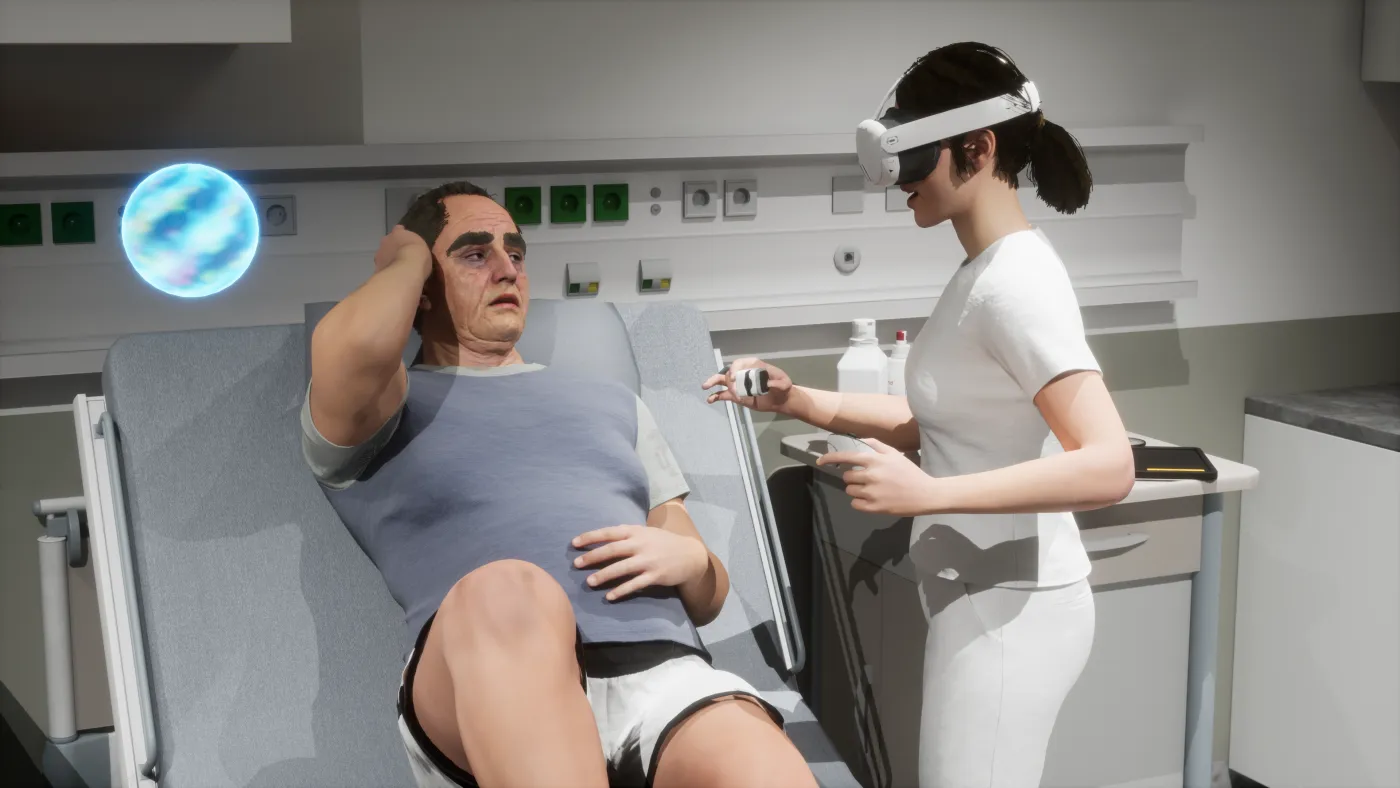
VR medical training: a nurse wearing a VR headset treats a virtual patient in a simulated hospital room

Your challenges

Sound familiar?

  • We have to onboard large groups of new nurses, fast.

  • Rare, high-risk cases can't be practised on real patients.

  • Aggressive patients and emergencies catch staff off guard.

Why now: Staff shortages, large onboarding waves and limited time with real patients.

How we solve them

From onboarding nurses to rehearsing surgery

Pick the skill you need to train first. Each offer links to a case or page with the details.

  • The problem

    “We have to onboard hundreds of new nurses, fast and to one standard.”

    SolutionCustom VR programme

    VR nurse training

    Your own patient room as a simulation, with your hygiene and care protocols.

    Every nurse and student gets the same standardised training, in their own language, without risk to patients.

    Proof
    University Hospital Bonn: 1,600 nursing staff and students
    Effort & price
    Starts with a design sprint · quote per project
    Discover the offer: VR nurse training
  • The problem

    “Rare, high-risk procedures can't be practised on real patients.”

    SolutionCustom VR modules

    Clinical skills simulation

    Tracheostomy care, paediatric emergencies and other high-risk care, practised until it's routine.

    Staff repeat the critical steps as often as needed, so the first real case is not the first attempt.

    Proof
    TracheoCare and PaediatricPro programmes
    Effort & price
    Quote per project
    Discover the offer: Clinical skills simulation
  • The problem

    “Our staff are unprepared for aggressive or distressed patients.”

    SolutionAI + VR

    AI virtual patients

    Patients driven by generative AI who react to what your staff say and do.

    Teams practise de-escalation and difficult conversations safely, as often as they need.

    Proof
    De-escalation training for medical personnel
    Effort & price
    Project, often starting with a pilot
    Discover the offer: AI virtual patients
  • The problem

    “Emergencies demand fast decisions under pressure.”

    SolutionCustom VR module

    Paramedic and emergency training

    Dynamic emergency scenarios that react in real time.

    Paramedics train the speed and pressure that classroom learning can't recreate.

    Proof
    Paramedic trainees felt better equipped for chaotic real situations
    Effort & price
    Quote per project
    Discover the offer: Paramedic and emergency training
  • The problem

    “Evacuating patients with limited mobility is hard to drill.”

    SolutionReady module + custom

    Fire and evacuation training

    Extinguishing and evacuation practice for care settings.

    Staff rehearse fire response and patient evacuation without disrupting the ward.

    Proof
    Evacuation training for medical facilities
    Effort & price
    Free demo · from €249/month per headset
    Discover the offer: Fire and evacuation training
  • The problem

    “Surgical skills are expensive to train and hard to plan.”

    SolutionCustom simulation

    Surgical and procedural training

    Portable robotic-surgery training and 3D views of a patient's own scans.

    Surgeons practise and plan before they reach the operating room.

    Proof
    Robotic surgeon training and 3D pre-operative planning
    Effort & price
    Quote per project
    Discover the offer: Surgical and procedural training

Proof from your sector

Results from teams like yours

nursing staff and students trained · University Hospital Bonn
1,600
published healthcare and care projects
13
  • University Hospital Bonn
  • UZ Brussel
  • Imelda
  • GS1

Practice without risk to patients.

Your hospital, your protocols

Tell us your challenge in two lines.

We'll point you to the right solution: a ready module, a custom VR programme or AI virtual patients.

  1. 1Contact
  2. 2Call
  3. 3Demo or proposal
  4. 4Start
  5. 5Support

After you get in touch

  1. 1We read it and route itYour message goes to the person closest to your problem — safety training, healthcare simulation, or AI infrastructure.
  2. 2You hear back within one business dayEither the answer to your question, or the two or three things we need to know before we can give you a useful one.
  3. 3If it fits, we book a technical conversationA working session with the people who would build it. No obligation, and no pitch deck.

Your contact

Evarest Schoofs

CEO & Founder

What to prepare

  • The skills or procedures you need to train
  • Number of trainees and sites
  • The languages your staff speak

We reply within one business day.

FAQ

Questions we often get

How is VR used in medical training?

Trainees step into a realistic clinical scene, such as a patient room, an emergency or an aggressive patient, and act with their own hands and voice. The scenario reacts to what they do and the instructor sees the result. They repeat it until the procedure is routine, without risk to real patients.

Does VR replace clinical placements or simulation labs?

No. VR adds practice where real patients or lab time are scarce: rare cases, high-risk procedures and large onboarding groups. Teams use it before and between hands-on sessions, so time in the lab or on the ward goes to what only real practice can teach.

Which headsets does it run on?

The nurse training programme for the University Hospital Bonn runs on Meta Quest 3 and Pico 4 Enterprise standalone headsets. They need no computer or cables, so a session can be set up in a normal classroom or meeting room.

Can the training run in more than one language?

Yes. The programme for the University Hospital Bonn trains domestic and international nursing students in German and English, with AI supporting the multilingual training.

What are AI virtual patients?

Virtual patients driven by generative AI that talk, react and change their behaviour based on what the trainee says. Healthcare staff use them to practise difficult conversations and de-escalation with aggressive or distressed patients.

How do we get started?

Most teams start with one module or a short pilot with a small group, then scale to more staff and sites. Tell us which skills you need to train, how many trainees you have and which languages they speak. We reply within one business day.