This blog argues that AI infrastructure should no longer be judged only by raw compute, but by how efficiently it turns power into useful inference. As AI adoption grows, inference is becoming the dominant driver of cost, energy use, and business value, which makes cost per token a far more important metric than hardware specs alone. The article also explains that real inference economics depend on the full serving stack, not just the GPU, and positions OneBonsai as a partner that helps organizations optimize this across cloud and local environments. In short, the future belongs to systems that can deliver intelligence at scale with the best possible efficiency.
From Electron to Inference
In the AI era, infrastructure is no longer judged only by how much compute it contains. It is increasingly judged by what it can produce. NVIDIA has been pushing this idea clearly: data centers are evolving into AI factories, and the real output of those factories is no longer just compute cycles, but tokens. In that sense, the journey from electron to inference is becoming the core story of modern AI infrastructure.
This shift matters because AI economics are changing. Training still captures attention because it is expensive, highly visible, and associated with frontier breakthroughs. But training is only part of the total lifecycle. Once a model is deployed, value is created through inference, again and again, across every prompt, workflow, agent loop, and production use case. That is why the center of gravity is moving from building models to serving them efficiently at scale.
According to Deloitte's TMT Predictions 2026, the Deloitte expects inference to account for roughly two-thirds of AI compute in 2026, up from one-third in 2023 and half in 2025. That does not mean training becomes unimportant. It means the long-term economics of AI are increasingly shaped by deployment. Research on AI lifecycle energy use points in the same direction, with recent estimates suggesting inference can account for up to 90% of a model’s total lifecycle energy use in large-scale deployments. In practical terms, many organizations may end up spending far more over time on serving intelligence than on creating the model in the first place.
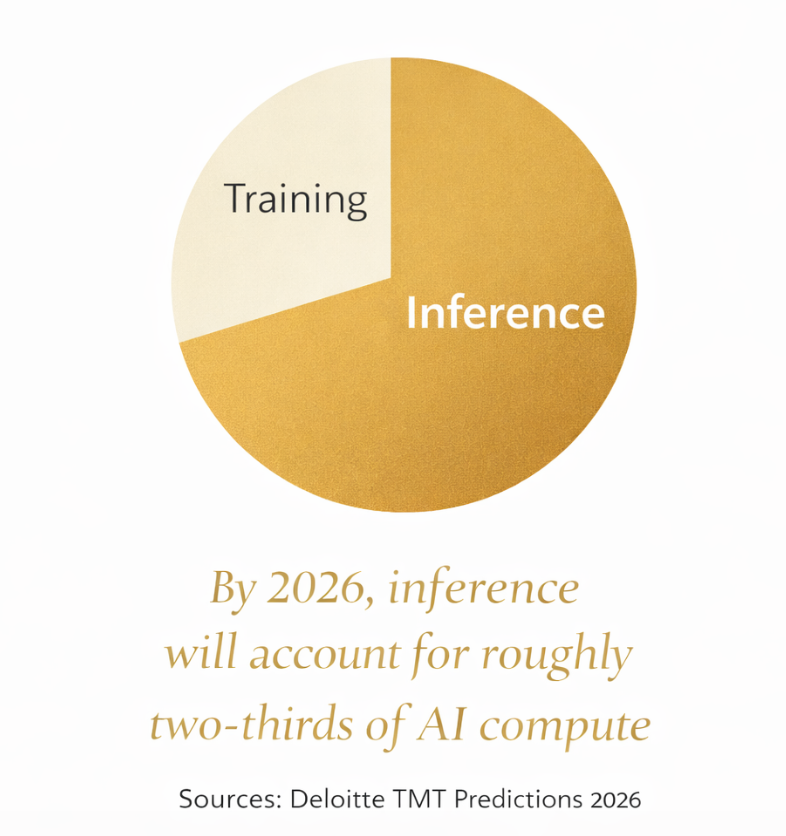
From compute input to intelligence output
Traditional infrastructure thinking tends to focus on inputs:
- cost per GPU per hour
- FLOPS per dollar
- peak memory bandwidth
- theoretical hardware performance
These metrics still matter, but they do not tell the full story. They describe what goes into the system, not what comes out.
For AI in production, the more important question is: how efficiently can infrastructure turn power into useful inference?
This is why cost per token is becoming such an important metric. Rather than focusing only on hardware cost, it measures how efficiently an AI stack produces actual output. NVIDIA’s recent framing makes this explicit: cost per million tokens depends not only on the hourly cost of a GPU, but on how many tokens each GPU can produce over time. The numerator matters, but the denominator is where real economic leverage is created.
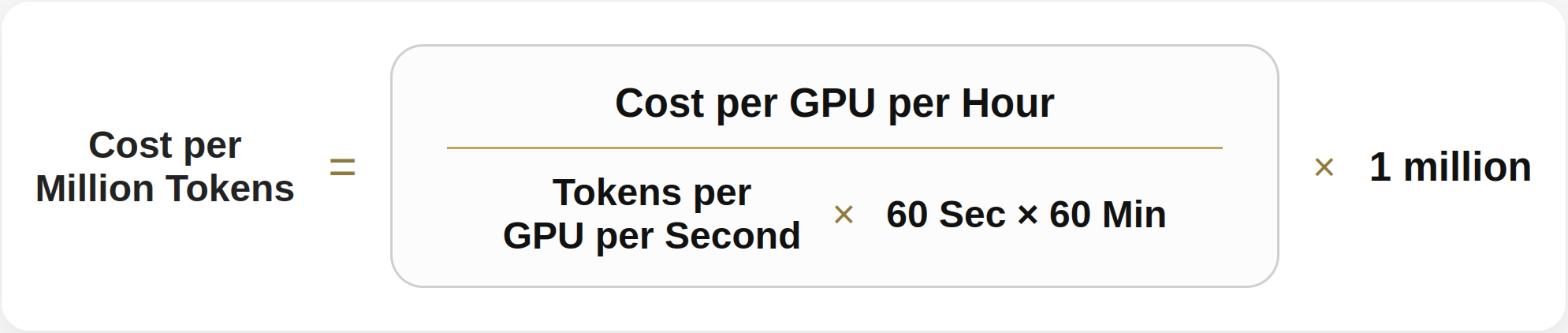
Cost per million tokens equation visual
Why tokens are becoming the unit that matters
Tokens may sound like a technical detail, but they are rapidly becoming a business metric. Jensen Huang recently described intelligence tokens as the new currency and AI factories as the infrastructure that generates them. That language is important because it reframes AI output in operational terms.
A token is no longer just a unit inside a model. It is also a unit of cost, throughput, latency, productivity, and eventually margin.
That matters even more because token economics are moving fast. Stanford’s 2025 AI Index(https://hai.stanford.edu/news/ai-index-2025-state-of-ai-in-10-charts) reported that the cost of querying a GPT-3.5-level system dropped from 20 Dollars per million tokens in November 2022 to just $0.07 per million tokens by October 2024. That is a reduction of more than 280 times in about 18 months. As token generation gets cheaper, the strategic question shifts from “Can we run this model?” to “How efficiently can we scale real-world inference?”
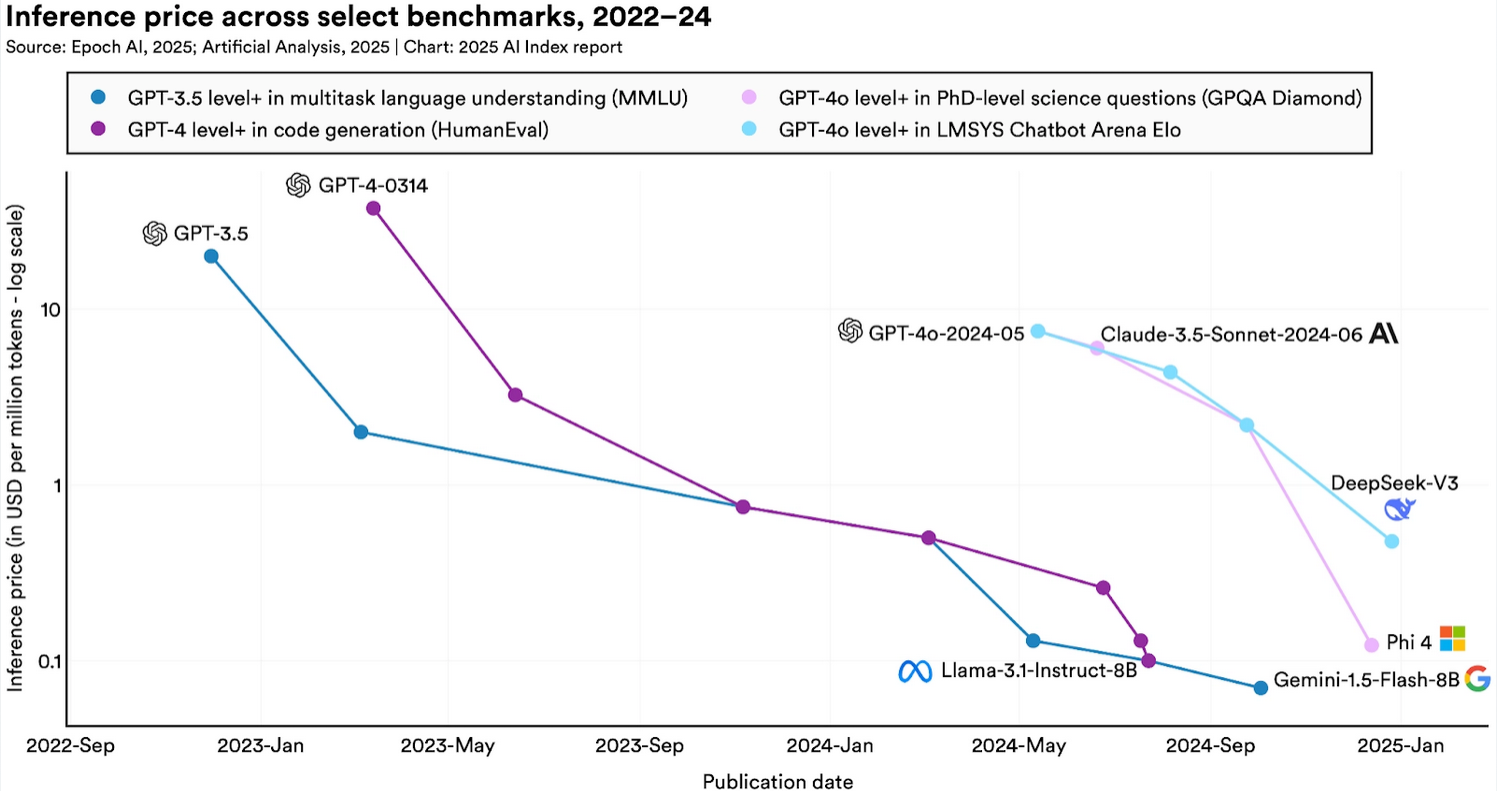
Inference price across select benchmarks. Source: Stanford HAI, AI Index 2025
The inference iceberg
One of the most useful ways to explain this shift is through the idea of the inference iceberg.
Above the waterline are the visible metrics that people compare first:
- Chip Specifications
- GPU Hourly Pricing
- Advertised FLOPS
- Raw Hardware Benchmarks
Below the waterline are the factors that actually shape cost per token in production:
- Software Optimization
- Batching Strategy
- KV Cache Efficiency
- Precision Formats
- Network Design
- Memory Behavior
- Orchestration
- Utilization
- End-To-End System Codesign
This is where real inference economics are decided. A cheaper GPU hour does not automatically mean cheaper intelligence. What matters is whether the full stack can deliver more useful output per unit of energy, time, and infrastructure cost.
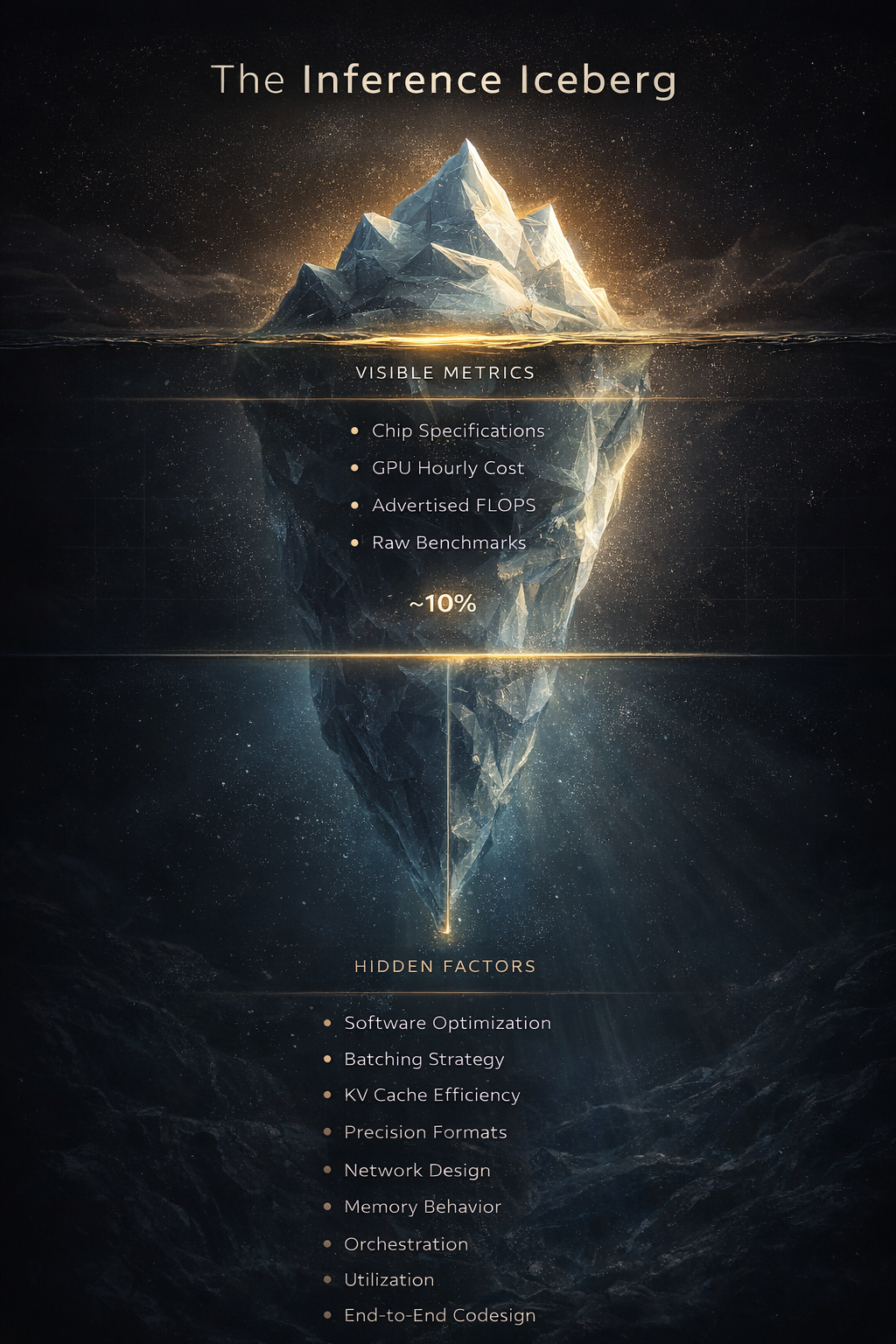
Inference Iceberg Visual
Why inference changes the business case
This is the deeper transformation from electron to inference.
Electricity powers infrastructure. Infrastructure enables computation. Computation drives inference. Inference generates tokens. Tokens become usable intelligence inside products, services, copilots, agents, and operational workflows.
That full chain is what enterprises increasingly need to optimize.
This is also why the economics of AI are no longer captured well by training cost alone. Training is a major upfront investment, but inference is where organizations feel AI every day: in latency, throughput, cloud bills, energy demand, user experience, and margins. Once a model is in production, the question is no longer only how smart it is. The question is how affordably and reliably it can serve intelligence at scale.
NVIDIA’s recent Blackwell-related examples point in exactly this direction. The company highlights cases where inference providers such as Baseten, DeepInfra, Fireworks AI, and Together AI have reduced cost per token significantly through full-stack optimization. Whether one looks at those examples as vendor case studies or market signals, the conclusion is the same: as AI matures, value shifts toward those who can run inference efficiently in production.
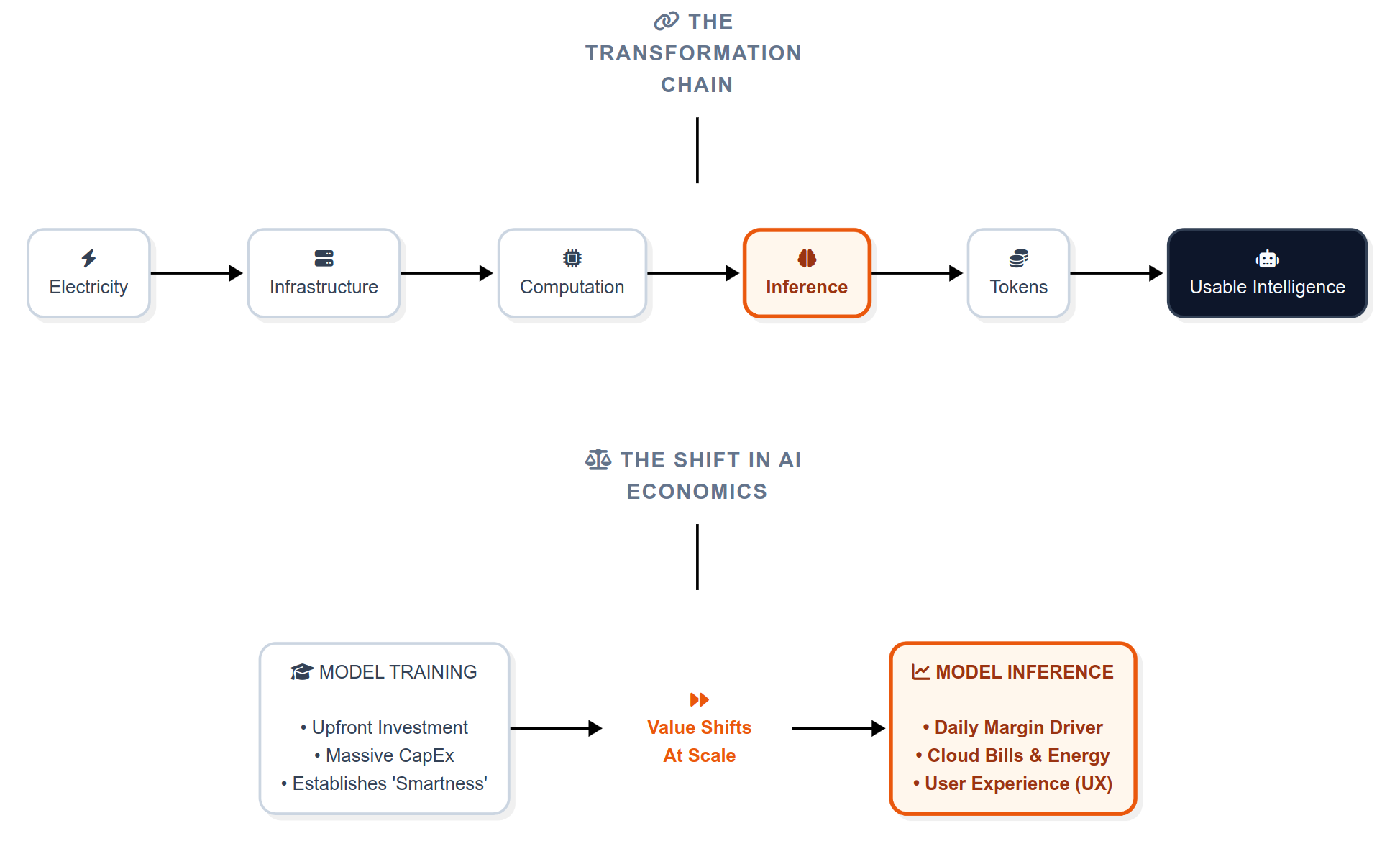
Inference Transformation.
What this means for enterprises
For most organizations, AI success will not be decided only by who trained the model. It will be decided by who can deploy intelligence sustainably, responsively, and economically.
That is why inference deserves more strategic attention. It is where infrastructure performance meets business value. It is where technical efficiency becomes financial efficiency. And it is where AI moves from experimentation into scalable operations.
In that sense, the move from electron to inference is not just a technical evolution. It is a new way of understanding the economics of AI itself.
Where OneBonsai fits in
For enterprises, this shift from compute input to intelligence output creates a practical challenge: AI inference must be designed, optimized, and operated as a full-stack system. That is where OneBonsai can help.
We help organizations optimize AI inference across both cloud and local environments, focusing on the metrics that matter in production: throughput, latency, utilization, and cost per token. Whether that means deploying and tuning vLLM, TensorRT-LLM, NVIDIA Dynamo, or other serving approaches on cloud platforms, NVIDIA-powered local servers, or VMware vSphere environments, the goal is the same: turning infrastructure into efficient, scalable intelligence delivery.
In practice, that includes selecting the right serving architecture, carrying out professional benchmarking, improving batching and memory behavior, reducing inefficiencies in deployment, and aligning infrastructure choices with real business requirements. It also includes helping organizations with model upgrades, model optimization, LoRA fine-tuning, and model training, so that AI inference performance is improved not only at the infrastructure layer, but across the full AI lifecycle. As inference becomes the dominant driver of AI economics, the winners will not simply be those with access to models, but those who can run, adapt, and improve them efficiently in the environments that matter most.
A simple way to explain it
The old view of infrastructure asked:
How much compute can we buy?
The new view asks:
How much useful intelligence can we produce?
That is the shift.
From electron to inference, the winning AI systems will be the ones that turn power into tokens, and tokens into value, with the lowest possible cost and the highest possible operational efficiency.