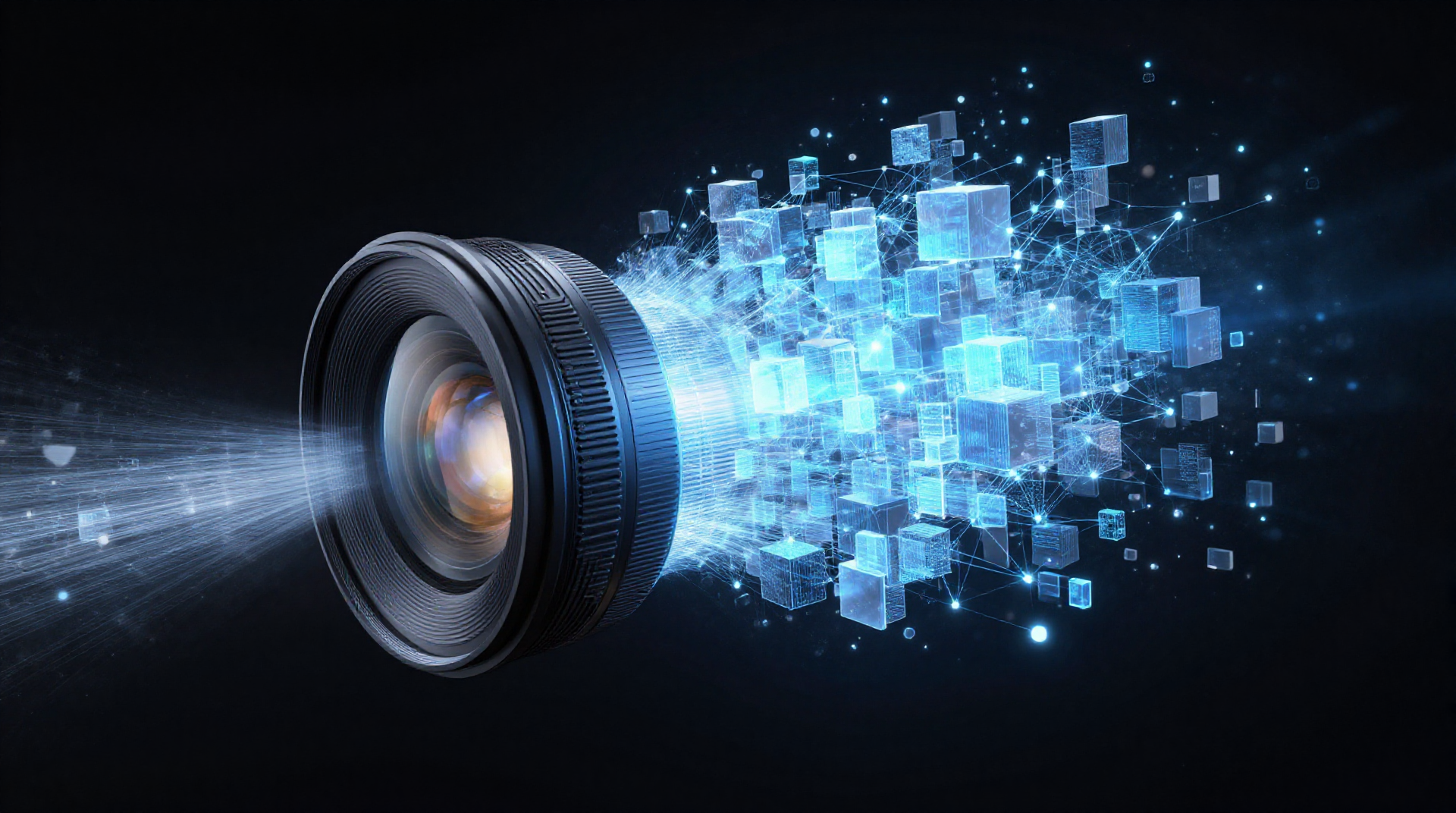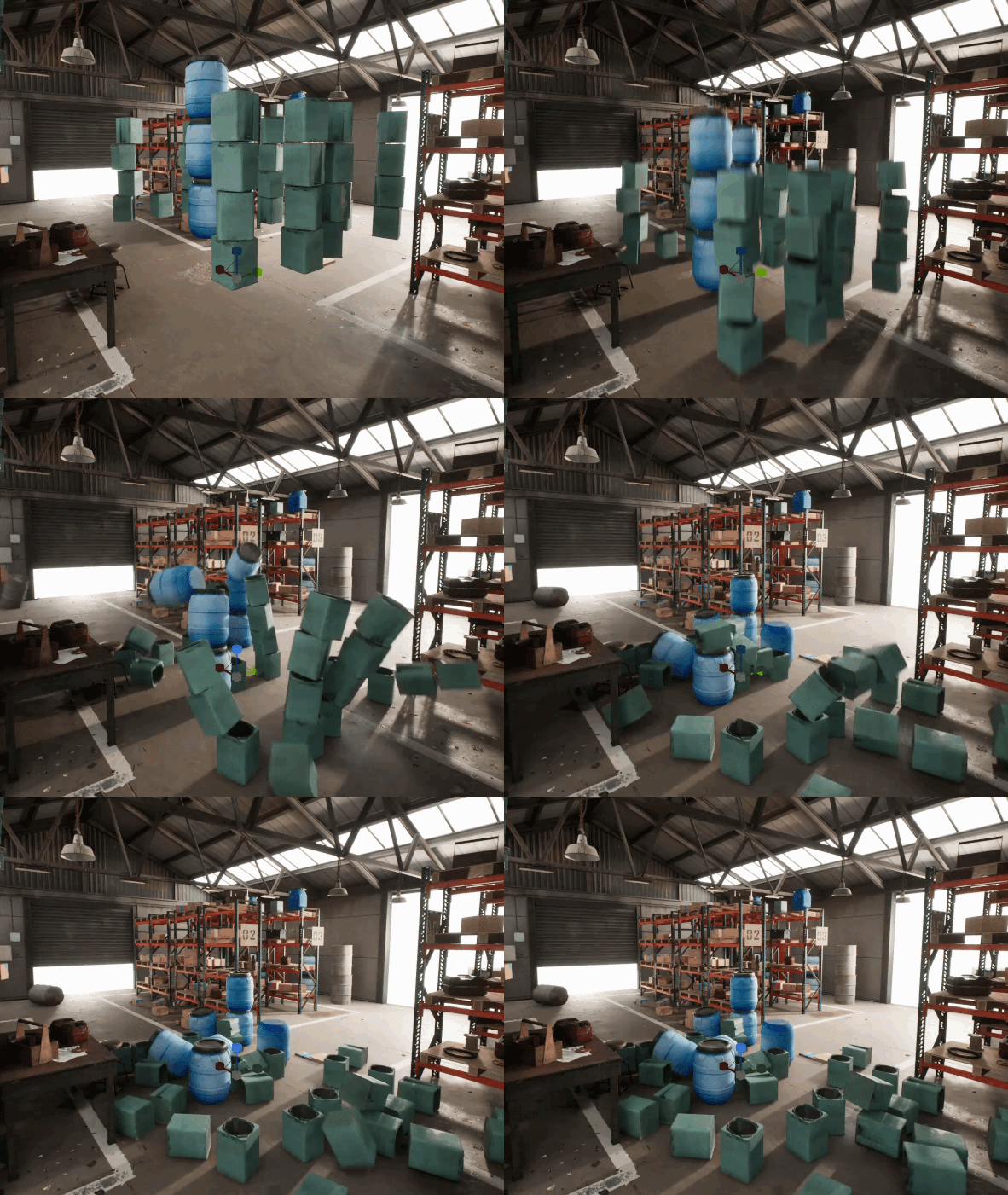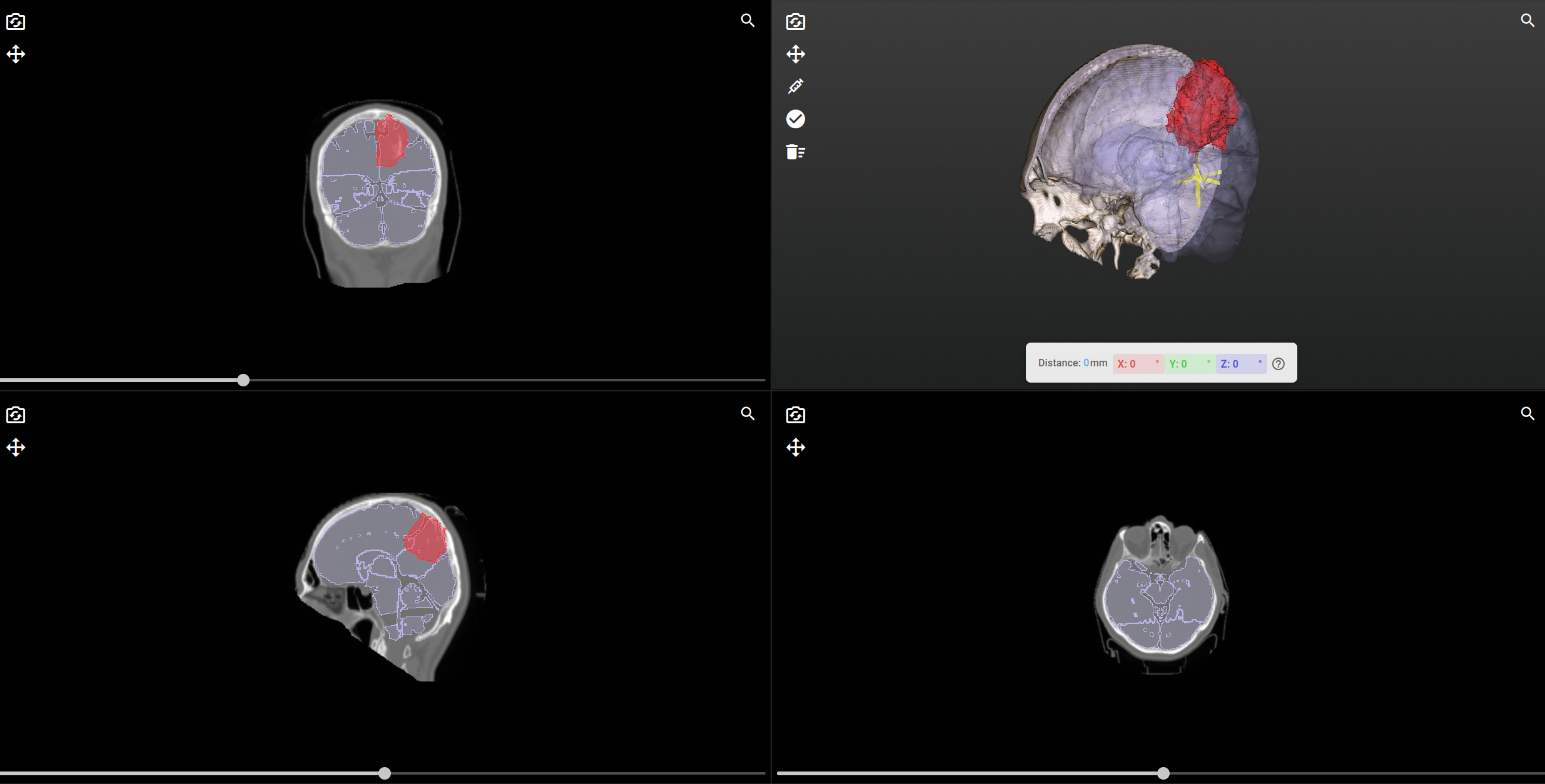
The TrueForm system utilizes an integrated computer vision framework to transform standard optical inputs into a high-fidelity biomechanical assessment environment. By leveraging deep learning architectures for real-time markerless motion capture, the platform provides precise spatio-temporal data regarding human movement patterns.
TrueForm
Sports Powered by Computer Vision
While wearable sensors have long dominated the fitness tracking space, they are intrusive and often fail to capture holistic body alignment. TrueForm explores the efficacy of computer vision specifically deep-learning-based pose estimation to provide a non-invasive, high-precision alternative for kinetic analysis. By synthesizing spatial coordinates into velocity and angular datasets, we aim to democratize professional-grade biomechanical feedback.
Architecture: From Pixels to Kinematics
Real-Time Body Pose Detection
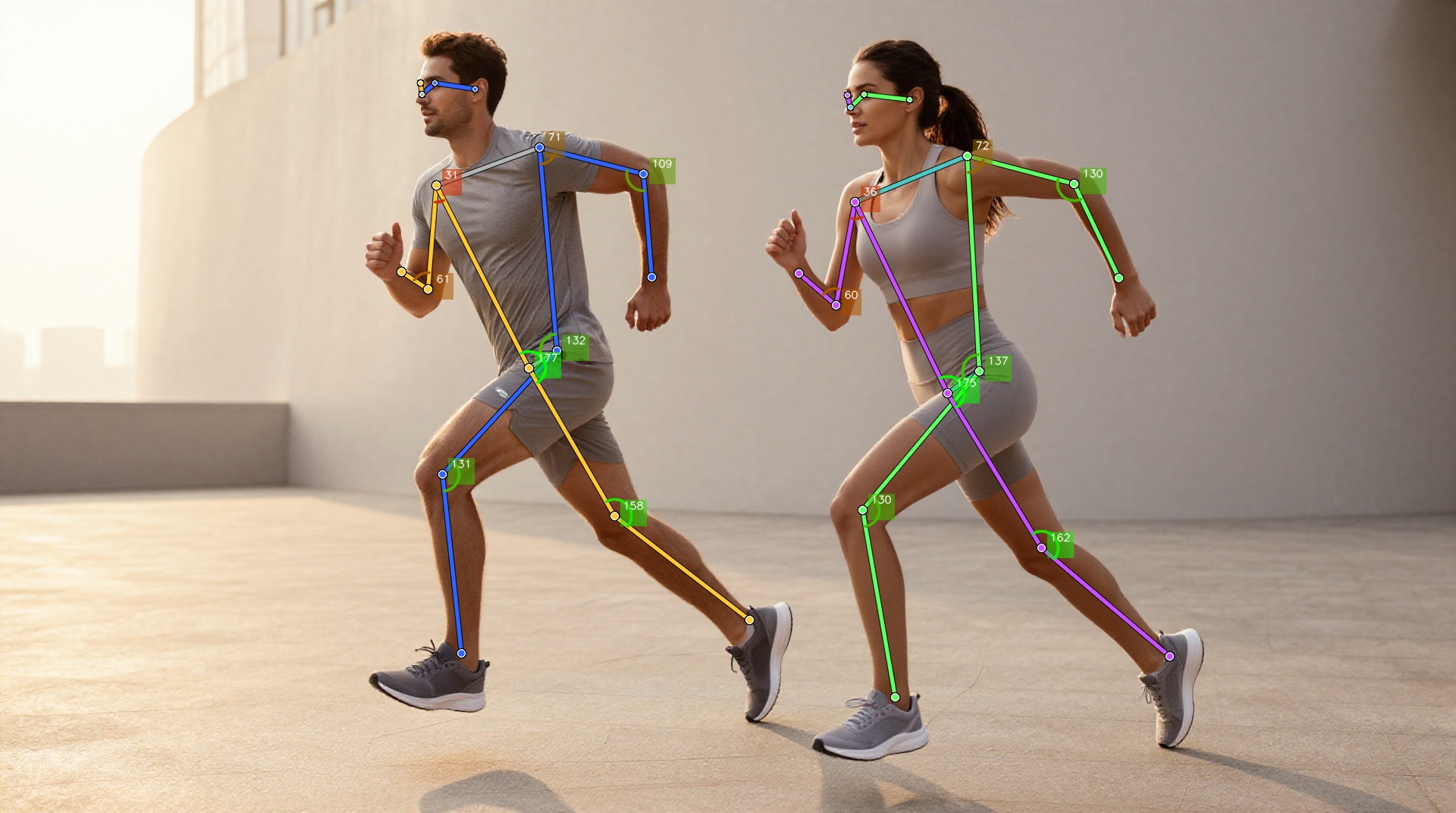
Using a state-of-the-art YOLO pose estimation model, the system detects 17 key body landmarks on a person in every single frame of a video including shoulders, elbows, wrists, hips, knees, and ankles with sub-second latency. This works on both pre-recorded workout videos and live webcam feeds.
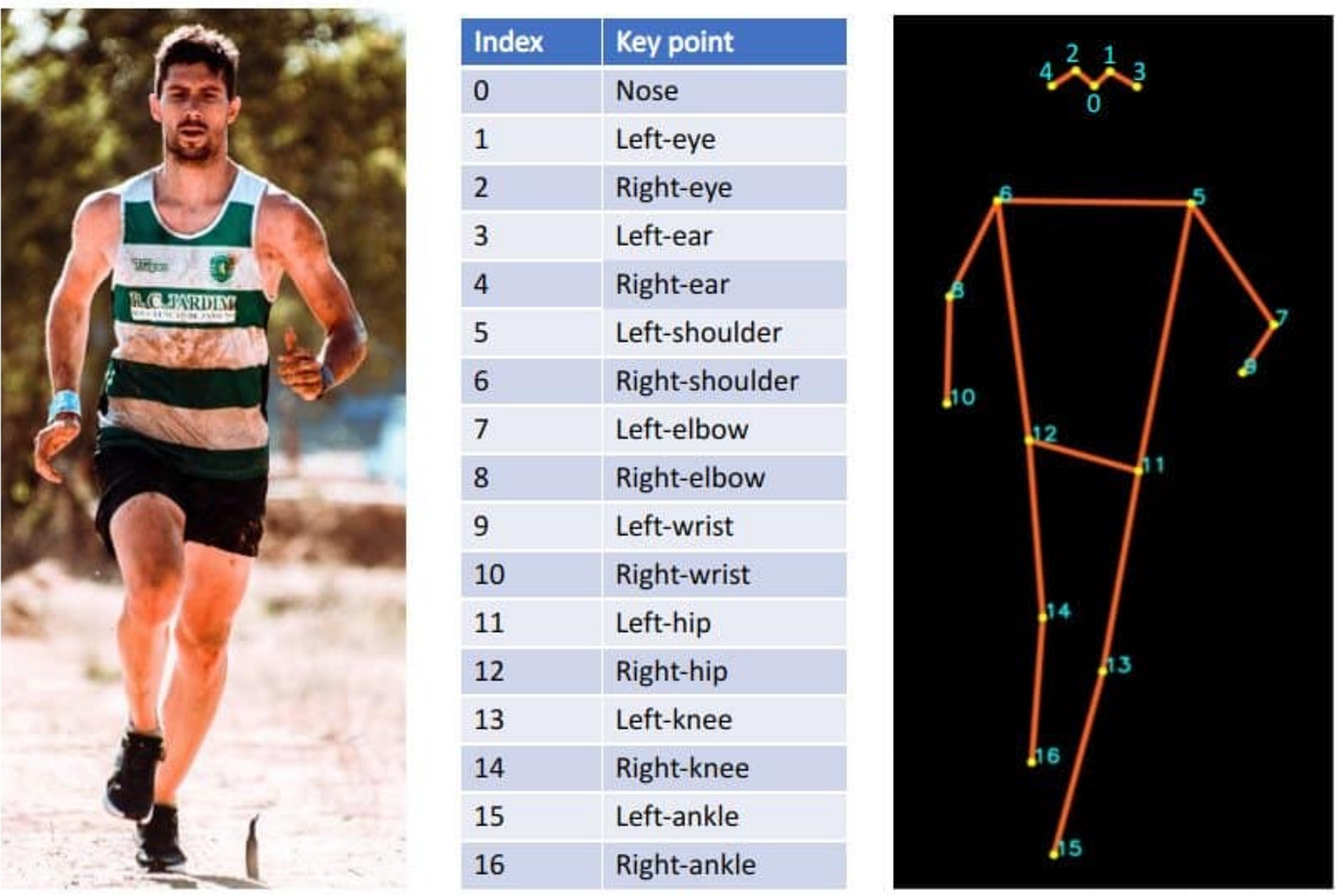
Source : learnopencv
Vector Geometry & Angular Analysis
To assess form, we treat the skeletal landmarks as a series of interconnected vectors. For any joint B (e.g., the elbow) connected to points A (shoulder) and C (wrist), the internal angle θ is calculated using the dot product:
θ=arccos(BA⋅BC∥BA∥,∥BC∥)\theta = \arccos\left(\frac{\mathbf{BA} \cdot \mathbf{BC}}{\lVert \mathbf{BA} \rVert , \lVert \mathbf{BC} \rVert}\right)θ=arccos(∥BA∥,∥BC∥BA⋅BC)
This mathematical approach allows us to monitor Spine Deviation and Range of Motion (ROM) with objective precision, flagging deviations that exceed a 5∘ threshold from the biomechanical ideal.
Velocity
The most significant research frontier in TrueForm is Movement Velocity Tracking. By calculating the Euclidean distance between landmarks across time t, we derive instantaneous velocity:
v=(x2−x1)2+(y2−y1)2Δtv = \frac{\sqrt{(x\_2 - x\_1)^2 + (y\_2 - y\_1)^2}}{\Delta t}v=Δt(x2−x1)2+(y2−y1)2
Joint Angle Analysis
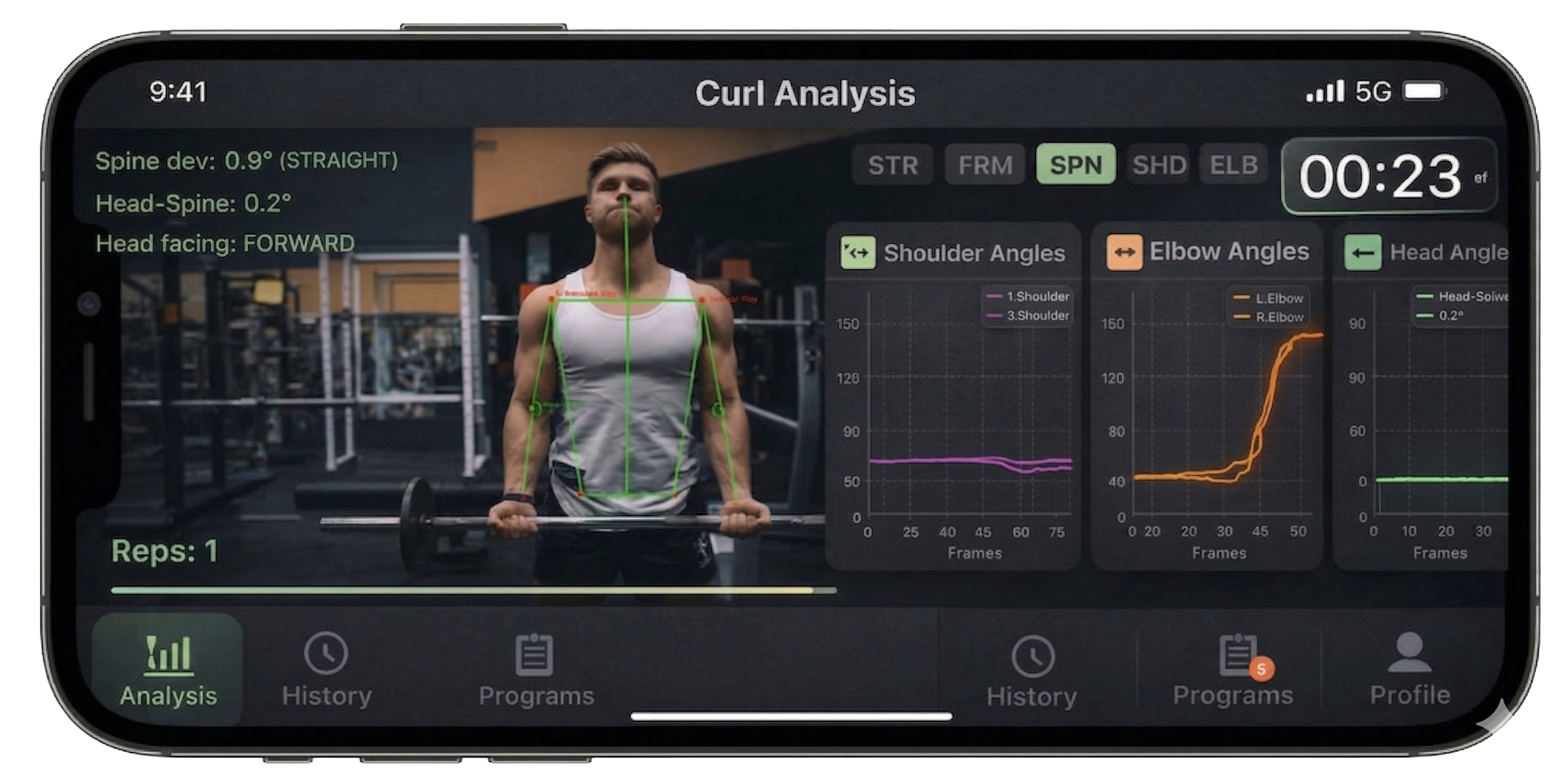
From those landmarks, the system calculates precise angles at critical joints. Every angle is plotted on a live, scrolling graph as the exercise progresses, giving a complete motion timeline at a glance.
- Joint angles: Measure range of motion during exercises.
- Spine deviation: Detects if the back is straight or dangerously bent.
- Head alignment: Flag forward head posture, a common and harmful pattern.
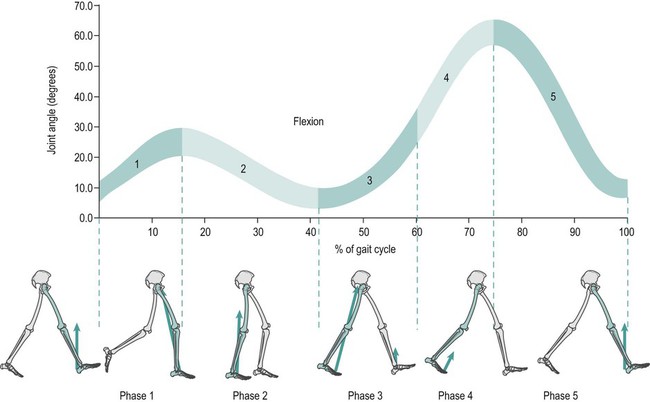
Movement Velocity Tracking
Beyond position and angles, the system measures how fast joints and limbs are moving throughout each rep. By tracking the pixel displacement of key landmarks across consecutive frames and normalizing by frame rate, it produces real-time velocity readings for each joint. Velocity data is plotted alongside joint angle graphs and is also exported to the keypoint CSV for offline analysis.
This unlocks a new layer of coaching insight:
- Concentric vs. Eccentric Speed: Identify whether an athlete is lifting explosively and lowering under control, or rushing both phases.
- Fatigue Detection: Decreasing velocity across a set is a reliable early signal of muscular fatigue, long before form visibly breaks down.
- Power Output Trends: Velocity data across a workout session can be charted to show peak output windows and recovery patterns.
- Sport-Specific Targets: Coaches can set velocity thresholds (e.g., bar speed for powerlifting or tempo targets for hypertrophy training) and receive alerts when an athlete falls outside the target range.
Automatic Rep Counter
The system counts repetitions automatically. It uses a smoothed signal on the elbow angles to detect the full flexion-to-extension cycle of a movement. No buttons to press it simply watches and counts, complete with cooldown logic to avoid double-counting fast reps.
Instant Form Feedback
On every frame, the video overlay displays:
- Color-coded skeleton: Drawn over the athlete's body (green = good alignment, red = issue detected).
- Spine status: STRAIGHT or BENT, with deviation shown in degrees.
- Head facing direction: FORWARD, TURNED, or UNKNOWN.
- Live rep count.
- Joint velocity readings for key landmarks.