Many AI projects fail not because the technology is weak, but because organisations start with the tool instead of the workflow. In knowledge-heavy environments, real value comes from building AI around how teams actually work.
Why Most AI Projects Fail in Knowledge-Heavy Organisations and What to Build Instead
Artificial intelligence has become a boardroom priority across industries. Leaders see the speed of technological change, the growing volume of information their teams must process, and the promise of doing more with less. In knowledge-heavy organisations especially, the appeal is obvious. If teams spend their days reading, analysing, summarising, coordinating, drafting, and making judgments, then AI should, in theory, unlock major gains.
And yet many AI projects quietly stall.
Not because the technology itself is weak. In many cases, the models are already capable enough to create real value. The problem is that organisations often approach AI as if it were a tool to attach to existing work, rather than a capability that has to be designed around how work actually happens.
That is why so many initiatives begin with excitement and end with little adoption, unclear returns, or a pilot that never becomes part of daily operations.
In knowledge-heavy environments, AI projects usually fail for reasons that are far more operational than technical.
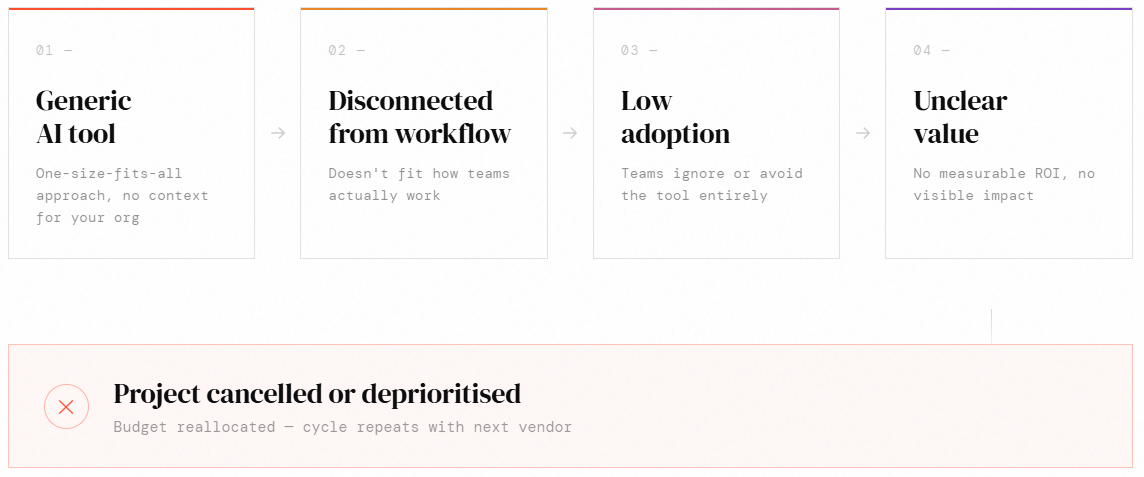
The mistake: starting with the tool instead of the workflow
One of the most common patterns is that organisations start with the question, "What AI tool should we use?" That sounds reasonable, but it is often the wrong place to begin.
Knowledge work is rarely clean, linear, or standardised. It happens across documents, emails, meetings, spreadsheets, shared drives, chat threads, CRM systems, and personal judgment. Much of its value does not come from raw information, but from interpretation: knowing what matters, what does not, what is urgent, what is relevant to a specific client or project, and what should happen next.
When organisations deploy generic AI tools into that environment without first understanding the workflow, the result is usually disappointing. The tool may be impressive in isolation, but disconnected from the context in which people actually work.
That is where friction begins.
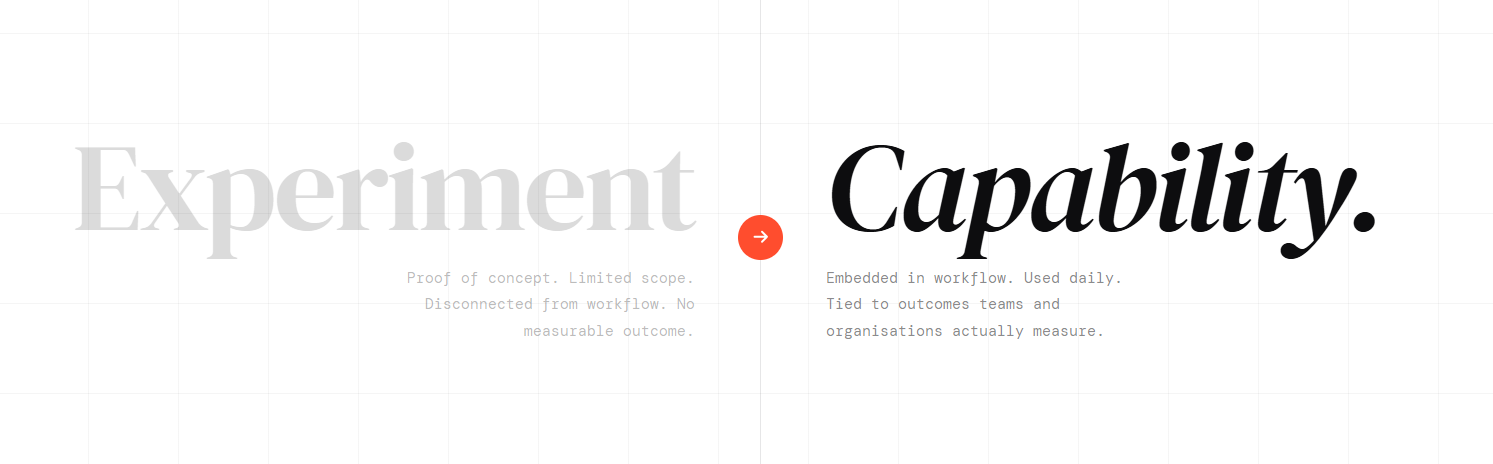
Why AI projects fail in practice
The first reason is that many organisations overestimate how structured their own knowledge is.
On paper, it may seem like information is already organised. In reality, valuable knowledge is often scattered across multiple systems, duplicated across teams, locked inside individuals' heads, or buried in formats that are hard to retrieve and reuse. If the underlying information environment is fragmented, AI will not magically fix it. It will simply reflect the same fragmentation back at the user.
The second reason is that relevance in knowledge-heavy organisations is rarely generic.
A policy update is not important just because it contains certain keywords. A stakeholder meeting is not valuable just because it happened. A document is not useful just because it exists in the archive. Relevance depends on mandate, client, timing, geography, strategic priority, and internal context. Generic AI systems are often good at generating language, but much weaker at understanding the specific logic that makes information meaningful inside an organisation.
The third reason is that too many projects are designed as isolated demos.
A chatbot may be built. A summarisation feature may be tested. A prototype may generate excitement in a workshop. But unless the solution is integrated into the team's real workflows, it often remains a novelty. People do not want one more tool to log into, maintain, or remember to use. They adopt systems that save time inside the flow of work they already have.
The fourth reason is that organisations focus on the visible part of AI and ignore the invisible part.
The visible part is the interface: the assistant, the dashboard, the automation, the output. The invisible part is what makes any of it useful: data structures, permissions, workflow logic, retrieval quality, governance, user trust, and operational fit. Most failed AI projects underestimate the importance of this layer.
The fifth reason is that success is defined too vaguely.
If the goal is "use AI more" or "become more innovative," the project will drift. Strong AI initiatives are built around concrete operational outcomes: reduce time spent on first-level triage, improve retrieval of internal knowledge, automate recurring reporting steps, surface relevant developments faster, or support more consistent delivery across teams. Without that clarity, it becomes difficult to design well, measure value, or gain adoption.
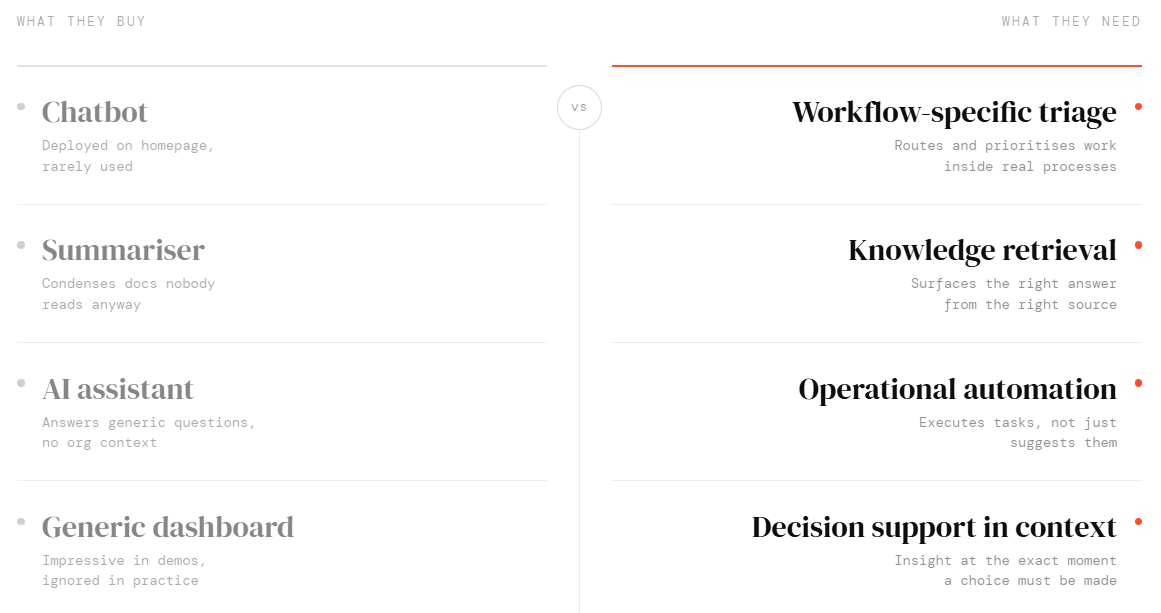
The real challenge is operational design
In knowledge-heavy organisations, AI is not mainly a model problem. It is a systems problem.
The question is not whether a model can summarise a document, classify an email, or answer a question. In many cases, it can. The real question is whether the organisation can define the task clearly enough, structure the context around it, and place the capability where it genuinely reduces friction.
That is why the most effective AI projects do not begin with a broad transformation narrative. They begin with a close look at where teams experience repeated pressure.
Where does information overload slow people down? Where do teams repeatedly search for the same things? Where is knowledge lost between projects, clients, or staff changes? Which tasks are repetitive but still require some judgment? Where is there avoidable manual coordination, unnecessary duplication, or weak visibility?
These are the places where AI can move from interesting to useful.
What to build instead
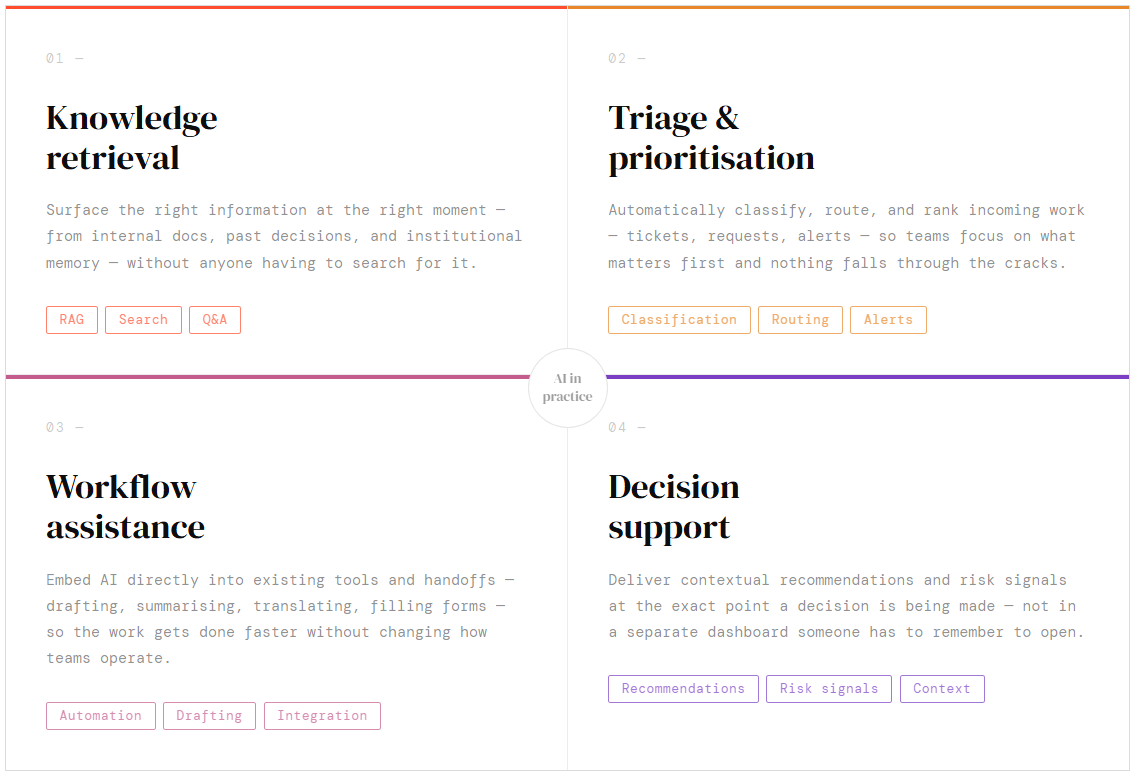
Instead of starting with a generic AI layer, organisations should focus on building targeted capabilities around real workflows.
One strong starting point is intelligent knowledge retrieval. In many organisations, people lose significant time searching for previous work, internal guidance, historical decisions, templates, client context, or sector-specific expertise. A well-designed AI-supported knowledge layer can make that information easier to find and reuse, but only if it reflects the way the organisation categorises and understands its own work.
Another high-value area is triage and prioritisation. Teams that monitor policy, regulation, markets, operations, or stakeholder activity often deal with more incoming information than they can realistically absorb. AI can help filter, cluster, and prioritise inputs, but the logic must be based on actual organisational relevance, not just surface-level keywords.
Workflow assistance is another practical category. Many teams spend time on recurring tasks such as drafting first versions, preparing summaries, updating trackers, routing requests, extracting actions from meetings, or standardising internal reporting. These are not flashy use cases, but they often create immediate value because they reduce routine workload without asking teams to completely change how they operate.
Decision-support dashboards can also be powerful when designed carefully. Not because dashboards themselves are new, but because AI can help synthesise multiple signals and surface what needs attention. In a client-facing or multi-project environment, that can mean giving teams a faster view of risk, priority, activity, and workload across accounts or workstreams.
Most importantly, these capabilities should be built around existing processes rather than in competition with them. The goal is not to force people into a new system for the sake of innovation. It is to make the systems and workflows they already depend on more useful, more intelligent, and less burdensome.
What successful organisations do differently
The organisations that get real value from AI tend to approach it with more discipline.
They do not start by asking what is technically possible in theory. They start by identifying where operational friction already exists.
They do not assume that a broad, one-size-fits-all tool will match specialised workflows. They understand that knowledge-heavy work depends on context, internal logic, and judgment.
They do not treat AI as a standalone experiment owned only by innovation teams. They involve the people who actually do the work, because those people understand where the inefficiencies, bottlenecks, and hidden complexities really are.
They do not measure success in abstract terms. They look for concrete improvements in speed, quality, consistency, visibility, and effort.
And they do not confuse a polished demo with a deployed capability. They know that adoption depends less on novelty and more on usefulness.
The best AI use cases are often the least glamorous
There is still a tendency to talk about AI in dramatic terms: autonomous strategy, fully transformed organisations, instant productivity revolutions. But in practice, many of the best AI use cases are much more grounded.
They help teams find the right document faster. They reduce time spent sorting through updates. They make internal knowledge easier to access. They automate repetitive preparation work. They improve consistency. They reduce operational drag.
That may sound less exciting than the headlines. But it is usually where real value is created.
Especially in knowledge-heavy organisations, the strongest AI projects are not the ones that sound the most futuristic. They are the ones that understand the daily reality of how people work and remove friction from it.
Conclusion
Most AI projects fail in knowledge-heavy organisations not because AI lacks promise, but because the project was framed incorrectly from the start.
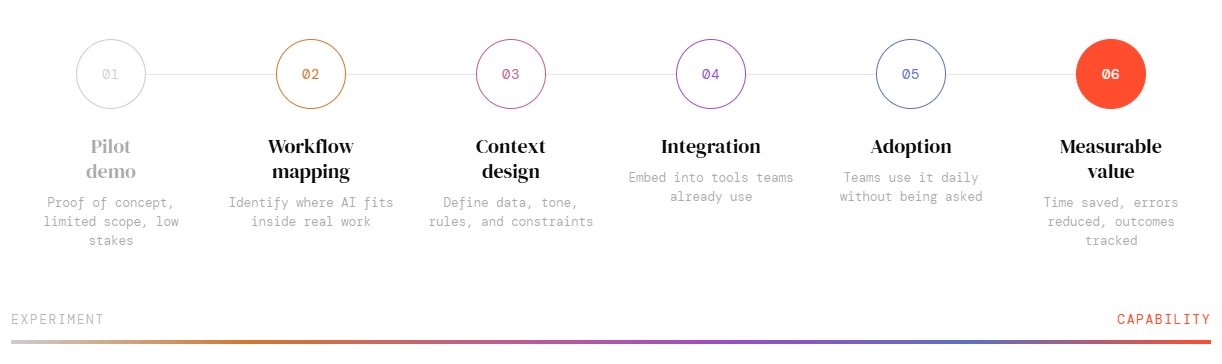
When organisations begin with the tool instead of the workflow, with the demo instead of the operating reality, or with broad ambition instead of specific pressure points, the result is often predictable: low adoption, weak integration, and unclear value.
The better path is more practical.
Start with how work actually happens. Identify where teams face recurring friction. Understand what relevance means in context. Build around existing processes. Focus on capabilities that improve retrieval, triage, coordination, and routine execution. Measure value in operational terms.
In other words, do not ask where AI could look impressive.
Ask where it could become useful.