Live extinguisher exercises and VR fire training teach different things. What each does well, where each falls short, and how to combine them.
An organisation that looks at VR fire training usually runs a live exercise already: a trainer, a controlled fire, a row of extinguishers, once a year or once every few years. So the practical question is not whether VR is any good. It is whether VR can replace what you do now.
The short answer is that it can replace part of it. The two methods teach different things, and the strongest programmes use both. This post sets out what each one does well, so you can decide where the line sits for your organisation.
What a live extinguisher exercise teaches
A live exercise puts a real extinguisher in someone's hands and a real fire in front of them. Nothing else gives the same physical experience:
- The weight and the handling. Carrying an extinguisher, pulling the pin and squeezing the handle feel different from reading about them.
- How short the discharge is. People are surprised by how quickly an extinguisher is empty. Feeling that once changes how they aim.
- Heat, noise and smell. A real fire produces a physical reaction that helps the lesson stick.
For people who have never held an extinguisher, this matters, and it is the reason live practice remains part of many programmes.
What a live exercise cannot do
The limits of a live exercise are practical, and they add up.
It teaches one moment of a fire. The trainee stands in front of a fire that someone else lit, in a car park or on a training ground, with the extinguisher already next to them. A real incident starts earlier: noticing the fire, raising the alarm, calling the emergency services, deciding whether to fight it or leave. Most of that cannot be staged with a fire tray.
The setting is not the workplace. Securitas Academy, which trains thousands of security staff, relied on fire trucks that had to be driven to each training site. The exercises were instructive, but hard to scale, and far removed from the buildings where staff would meet a fire. One of their trainees described the VR version this way:
While I know VR is not real, it felt more realistic than a staged fire. The fire was in an environment that makes sense.
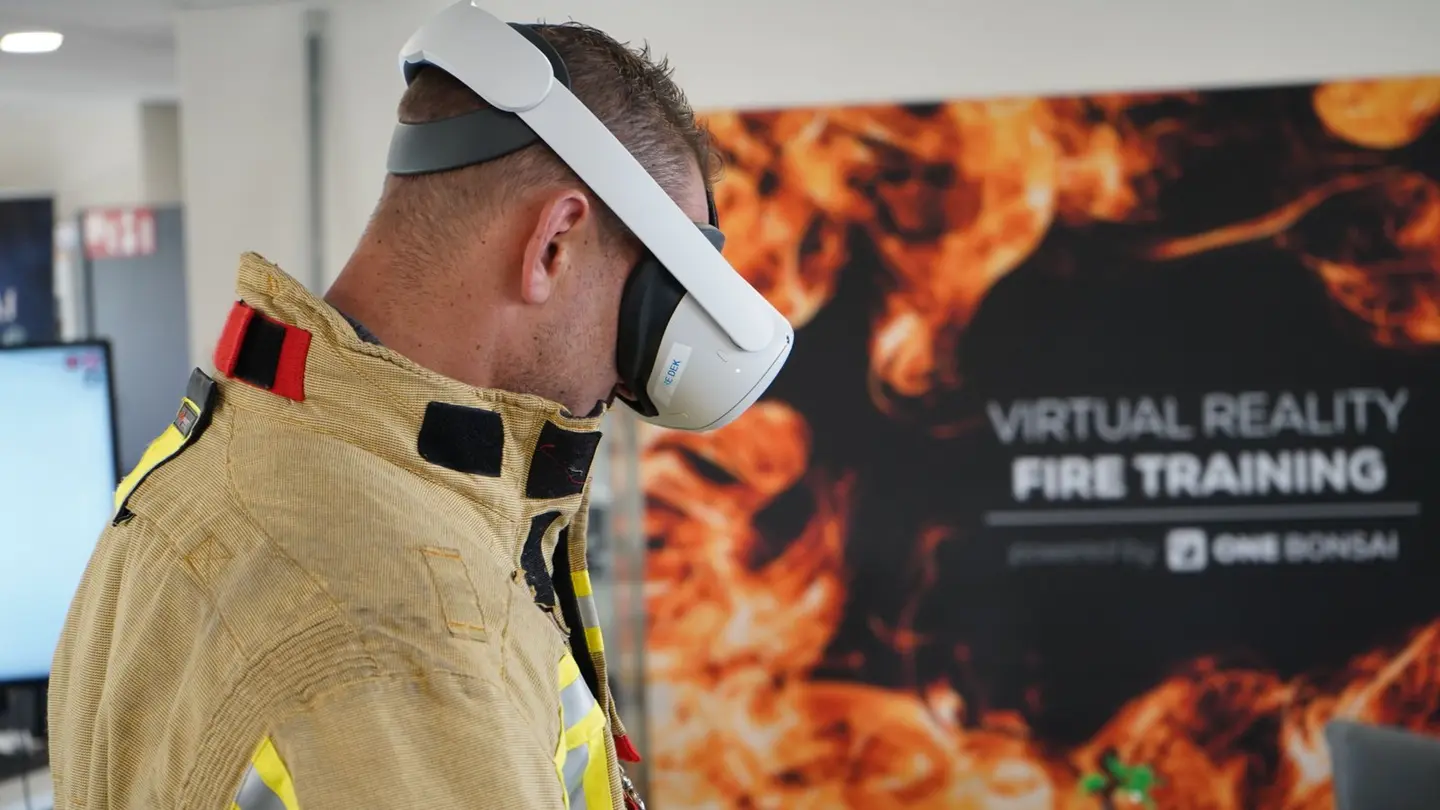
Each person gets very little practice. With a group and a limited number of refills, a trainee often gets one attempt. If it goes badly, there is rarely a second.
Every session costs again. A trainer, a location, refills, travel, and the hours each participant is away from work. Live drills also release CO₂ and extinguishing agents. A cost that returns with every session is one reason refreshers end up far apart.
What VR fire training adds
In VR, the trainee puts on a headset and is inside a workplace: an office, a warehouse, a factory, a care facility. A fire starts somewhere in it.
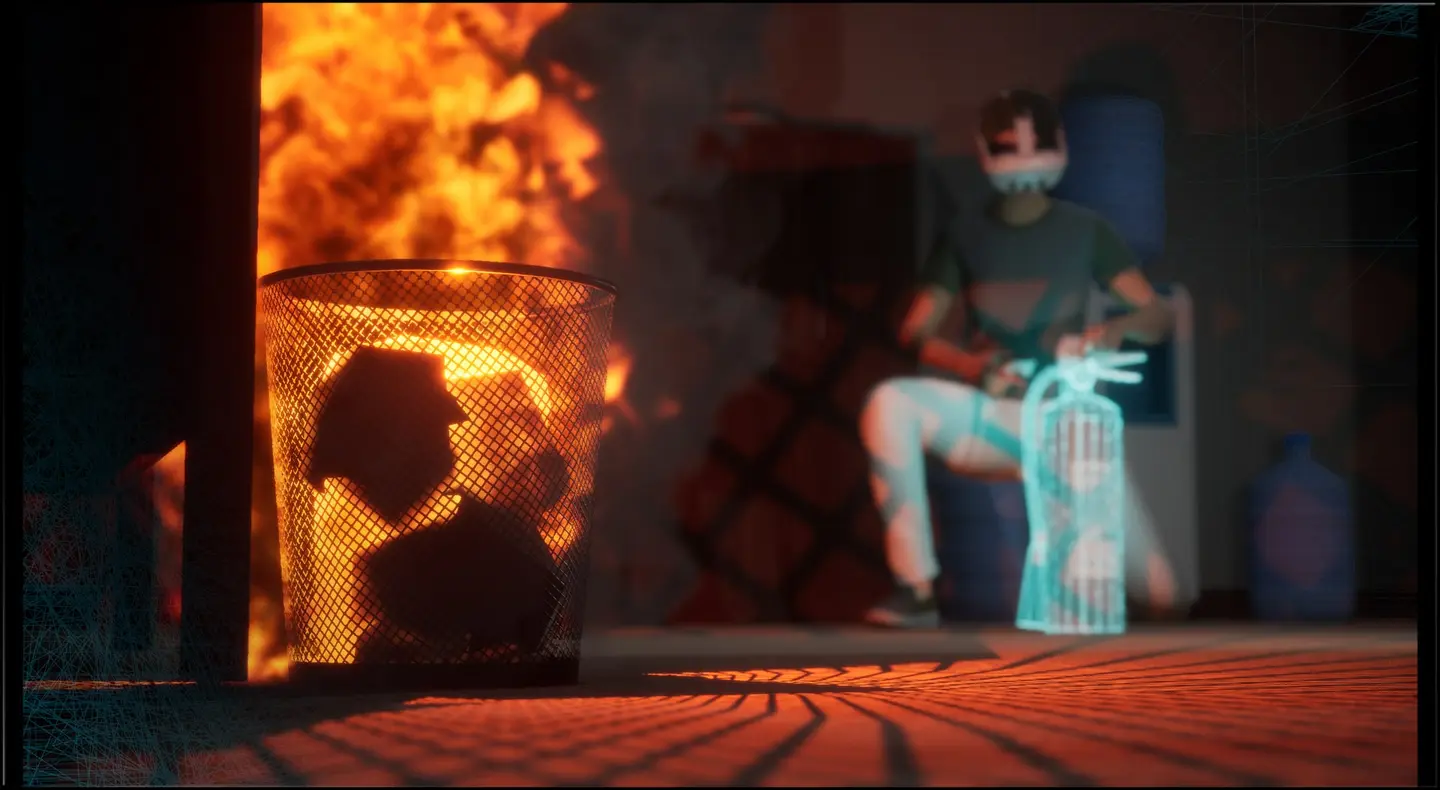
The whole sequence, not only the extinguisher. Our VR Fire Training module has more than 27 scenarios covering alarm buttons, calling the emergency services, extinguisher practice and the evacuation protocol. The trainee has to decide what to do, in order, and can decide wrongly.
Repetition. A session takes 10 to 20 minutes. A second scenario takes a few minutes more and costs nothing extra, so one person can practise several fires in the time a live exercise gives them one.
Situations nobody would stage. For NMBS, the Belgian national railway, we built fire training with hose operations, low-light fires and full evacuations inside station environments. For the Belgian Navy and the Royal Military Academy, crews fight a fire aboard a frigate with smoke, restricted visibility and a tracked fire hose. Neither can be rehearsed for real at any useful frequency.
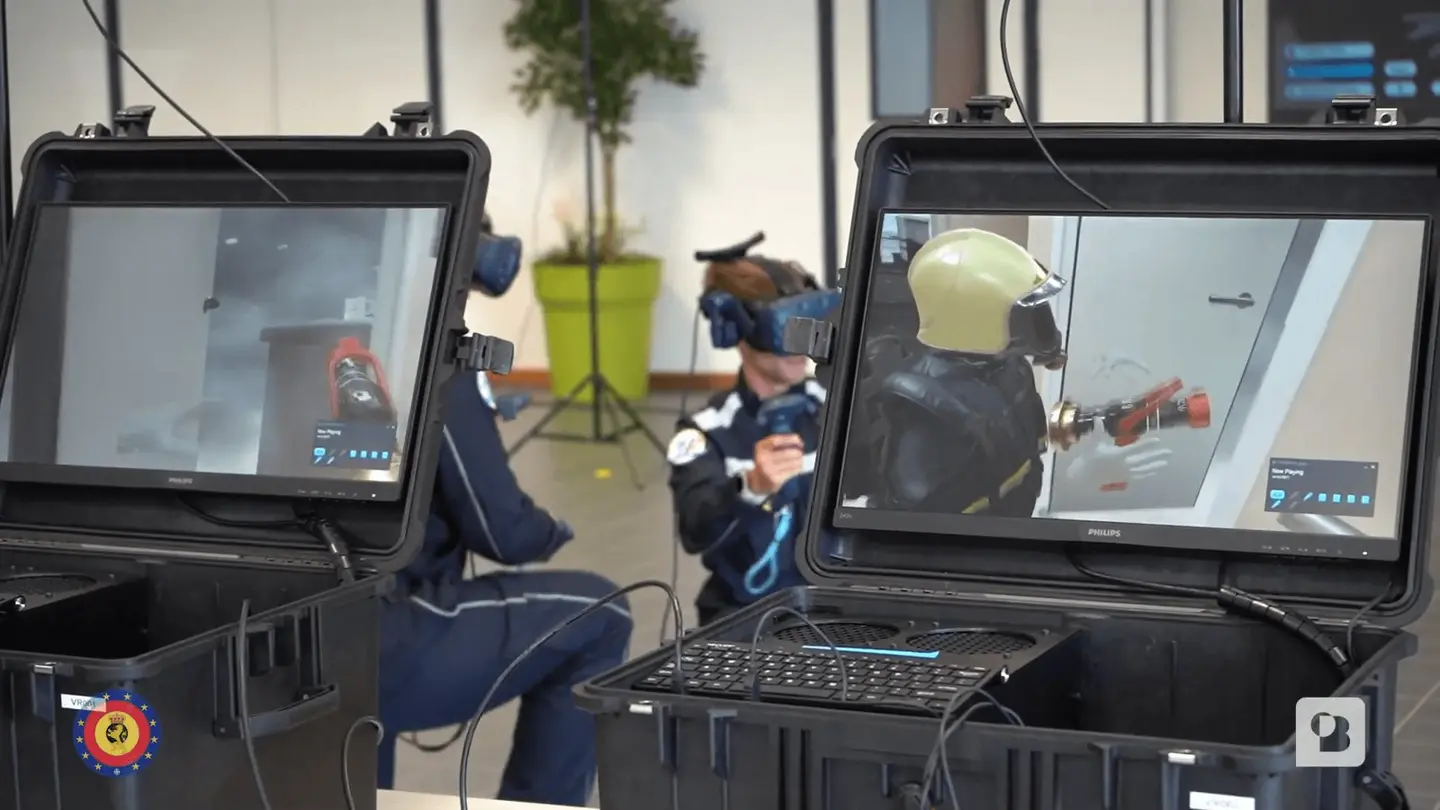
No travel and little space. Each trainee needs a headset and about 2 × 2 metres. Training comes to the site instead of the other way round, in more than ten languages.
A record per person. Performance tracking shows what each trainee did and where they went wrong, which a prevention advisor can use for follow-up.
Where VR falls short
VR has limits too, and it is better to plan for them than to discover them.
- There is no heat and no real weight. A standard controller does not feel like an extinguisher. For Securitas we built a modified real extinguisher that works in the simulation, which closes much of that gap. Without it, a short live session remains the best way to feel the real equipment.
- A small number of people get motion sickness. Modern headsets have reduced this, and keeping sessions to 10 to 20 minutes helps, but it has not disappeared.
- You need headsets. They are bought once, but they have to be charged, cleaned and looked after.
- It may not count on its own. What your regulator, sector or insurer accepts as fire training differs. Check this with your prevention advisor before you cancel anything.
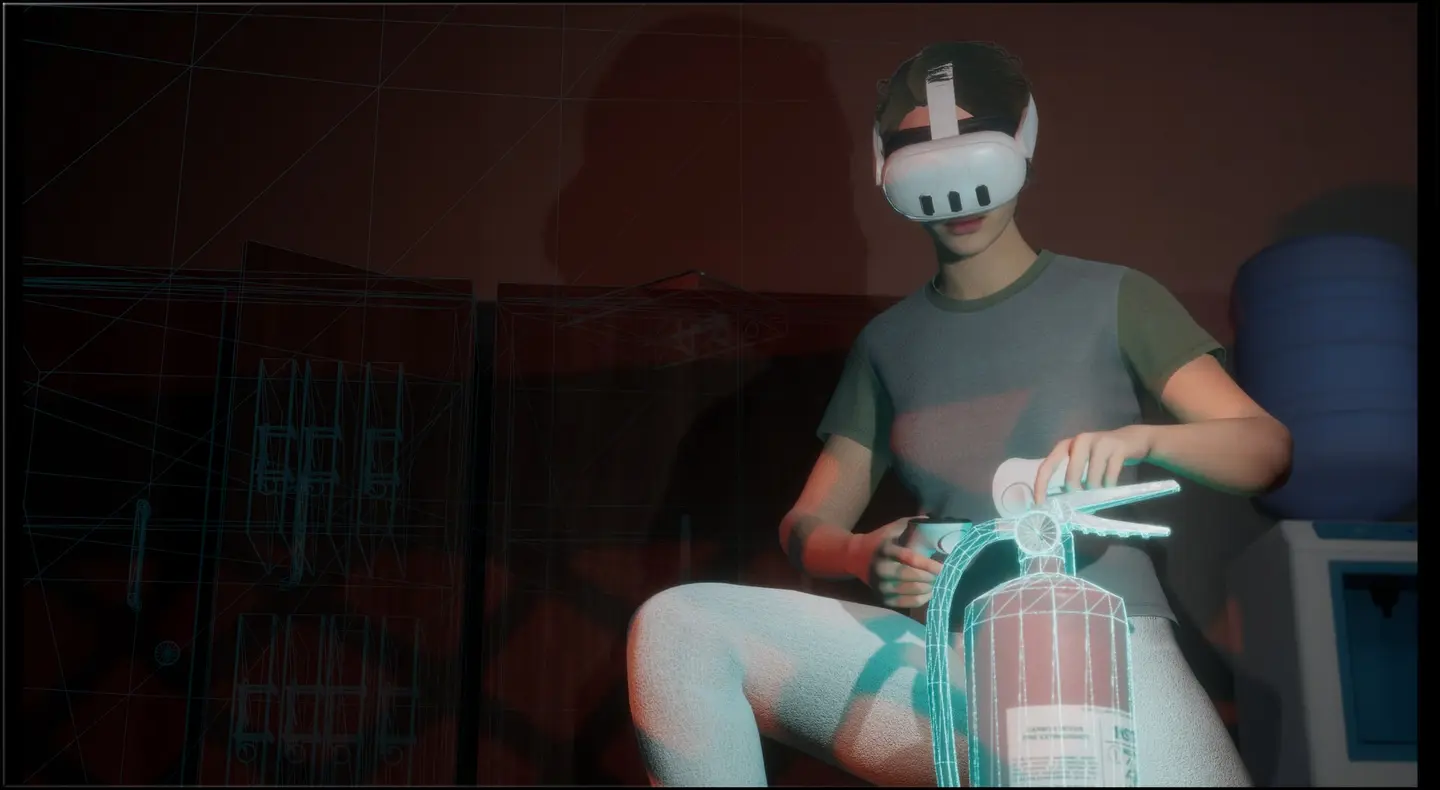
Mixed reality: the fire in your own room
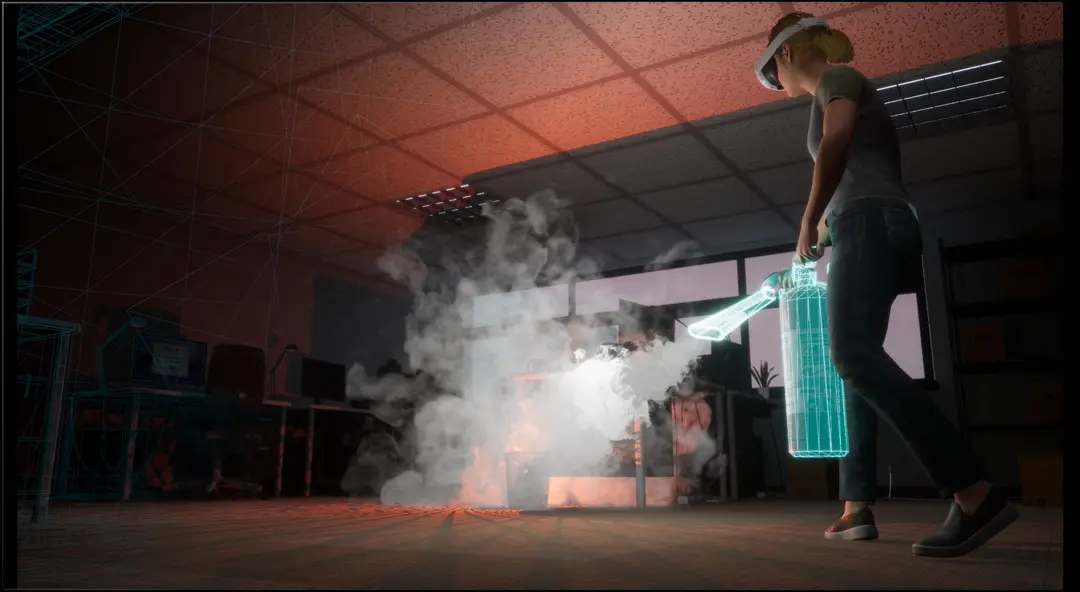
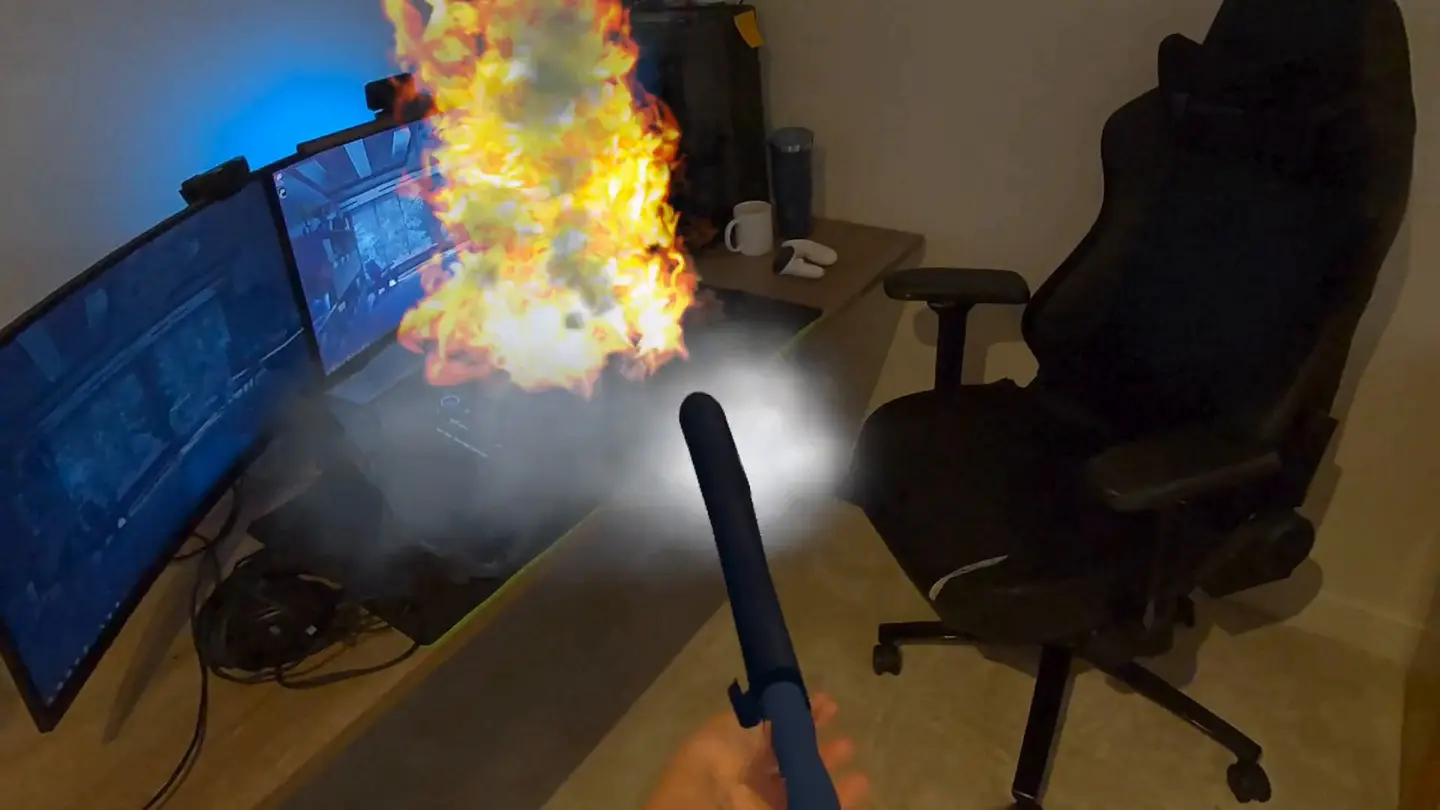
Mixed reality narrows the gap from the other side. The headset shows the real room, and the fire is added to it: on a desk, in a waste bin, next to the equipment people use every day.
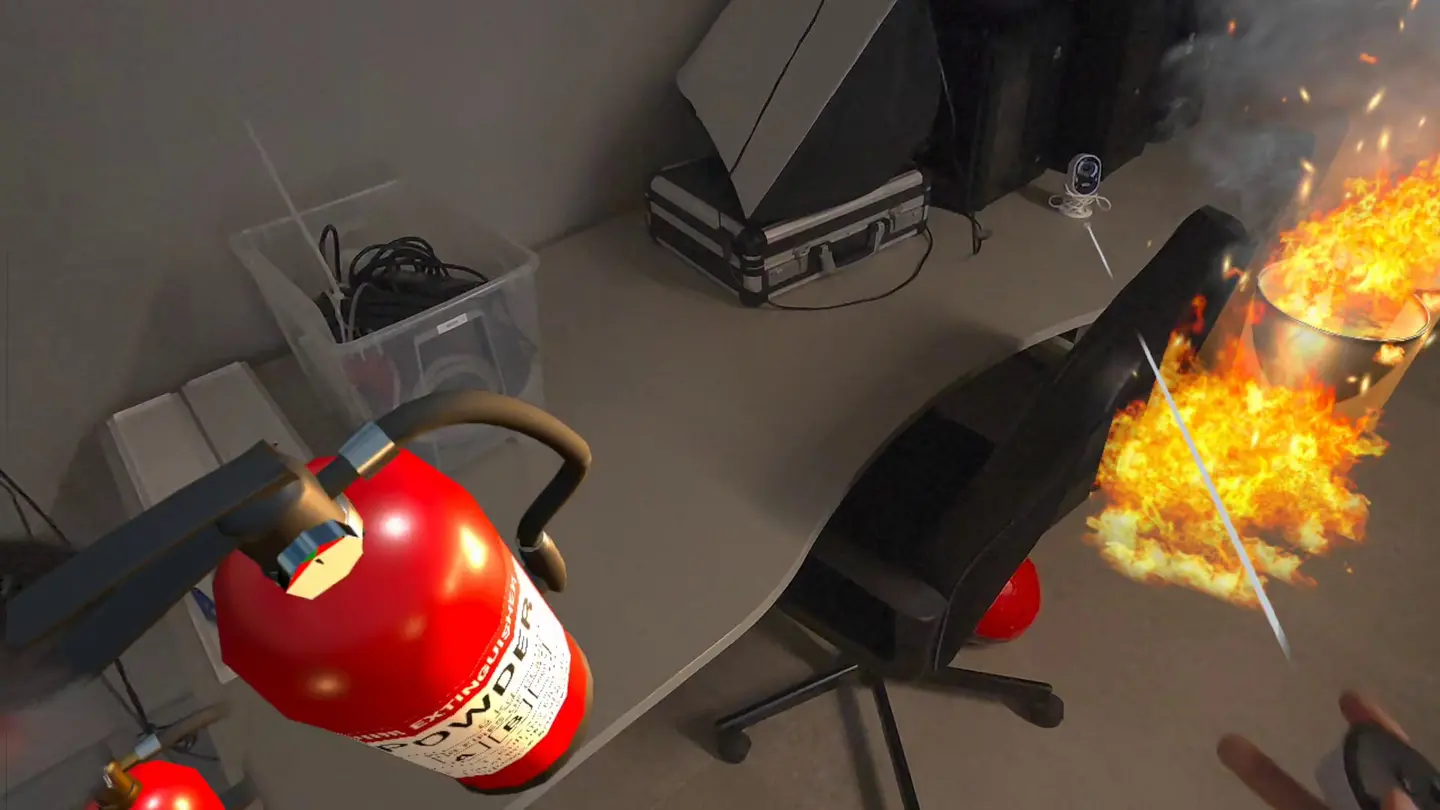
The stills here come from our mixed-reality fire training. Three things stand out:
- The room is yours. Trainees practise where they would have to act, with the real exits and the real obstacles.
- You set it up yourself. A layout creator lets you place virtual extinguishers over your real ones, add the fire alarm call point, a phone and the exit door, and choose where the fire starts.
- The details match. The extinguishers in the layout are the types you select: CO₂, foam, powder or water.
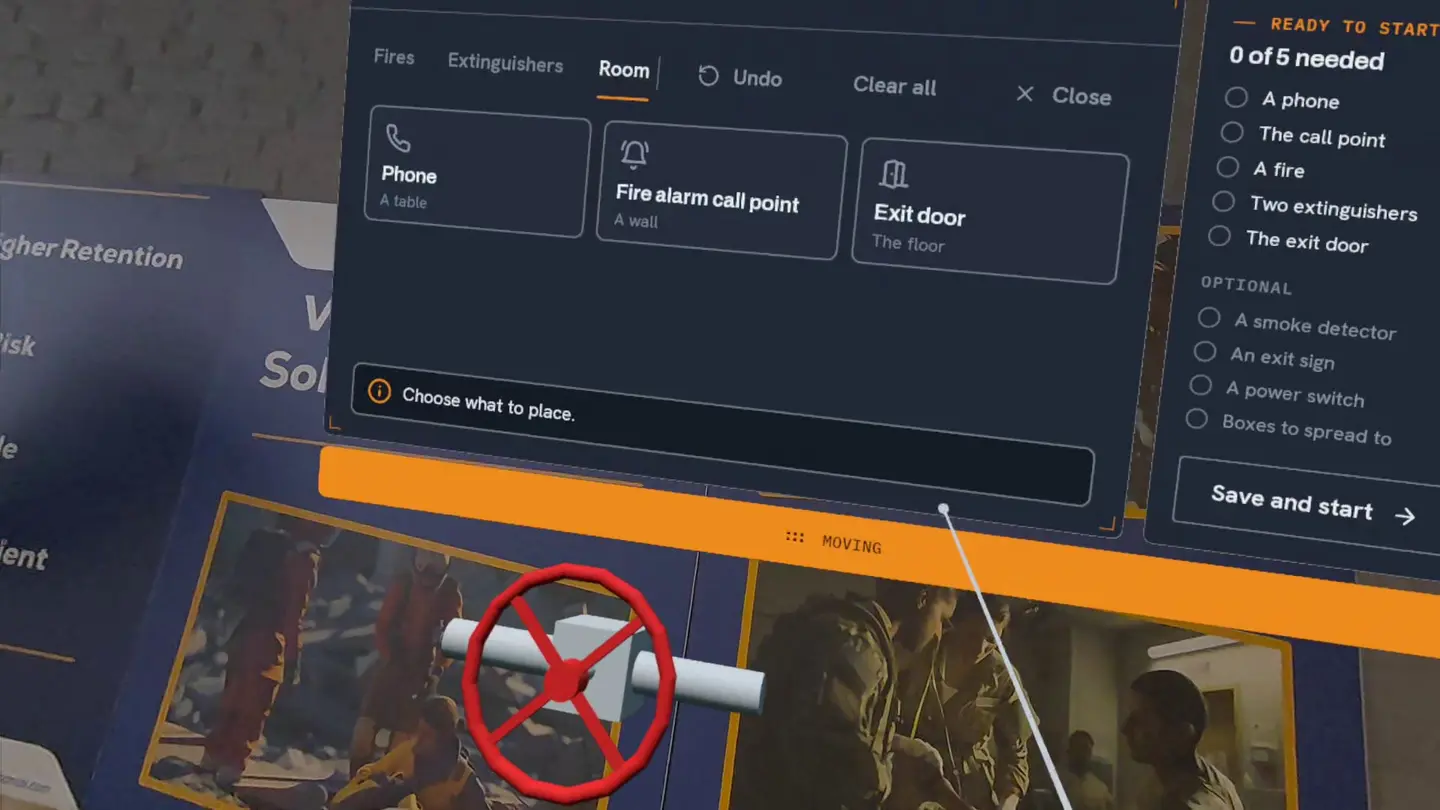
Mixed reality does not add heat or weight either. What it adds is the one thing a virtual office cannot offer: your own building.
Side by side
| Live extinguisher exercise | VR fire training | |
|---|---|---|
| Real equipment in hand | Yes | Only with a modified extinguisher |
| Heat and physical stress | Yes | No |
| Alarm, emergency call, evacuation | Rarely | Yes |
| Your own type of workplace | No | Yes |
| Attempts per person | Usually one | As many as needed |
| Cost of an extra session | Trainer, location, refills | Staff time only |
| Where it happens | Training ground or car park | On site, about 2 × 2 m per person |
| Record of individual performance | Rarely | Yes |
How organisations combine the two
The Securitas project shows what this looks like in practice: not replacement, but a new division of labour.
Securitas kept its traditional extinguisher exercises and added VR next to them. Within months, 20% of its traditional fire training sessions had been replaced by the VR version. Because the system is portable, it can be used at any client site, and it helped Securitas expand its client base by 30%.
A workable split looks like this:
- Live practice at a long interval, for the feel of real equipment, where your rules or insurer require it.
- VR in between, for everything around the extinguisher: detection, alarm, the emergency call, the decision to fight or leave, evacuation.
- VR for new starters, in their first weeks, instead of waiting for the next scheduled live session.
- VR for the scenarios that are specific to your site and cannot be staged.
Deciding where your line sits
Three questions settle most of it:
- What do you have to prove, and to whom? If a regulation or insurer names live practice, that part stays.
- What goes wrong in your incidents and drills? If people hesitate to raise the alarm or do not know the evacuation route, more extinguisher practice will not fix it.
- How many people, at how many sites, how often? The more of each, the more the per-session cost of live training limits you.
If you want to judge for yourself, every module has a free demo, and the Securitas case study describes the combined approach in detail. For the cost side of the comparison, see our guide on what VR safety training costs and returns.