AI moves faster than organisations can absorb it. What we told business owners in Leuven about language, avatars, local models and physical AI.
On Thursday 17 September we hosted a Deeptech Breakfast in Leuven, together with Voka Kamer van Koophandel Vlaams-Brabant. The room held manufacturers, contractors, accountants, logistics and energy companies, and a handful of AI companies, integrators and ERP consultancies. The talk was called Faster than it feels, and its argument fits in one sentence: AI is moving quicker than any organisation can absorb it, that gap can be measured, and for a company of thirty or three hundred people it is an advantage.
This is the written version, for those who were there and for those who were not.
Hands up
We started with three questions.
- Who used an AI tool this week?
- Keep it up if it changed a process, not just a task.
- Keep it up if your company would notice tomorrow if it stopped.
Try it in your own management team. The tools have arrived. The organisations have not moved. Everything else in the talk sits in that gap.
The pace
A few things that were not true three years ago and are ordinary now:
- The same model capability gets roughly ten times cheaper every year.
- A model fits in your own building. One workstation-class card runs models that needed a data centre two years ago.
- Robots and driverless vehicles are routine. Amazon has passed a million robots in its warehouses, Waymo has completed more than ten million paid driverless rides, and a commercial driverless freight service runs regular routes in Texas.
- Robot bodies got cheaper. Humanoid manufacturing costs fell by about forty percent in a single year.
The price of intelligence is collapsing
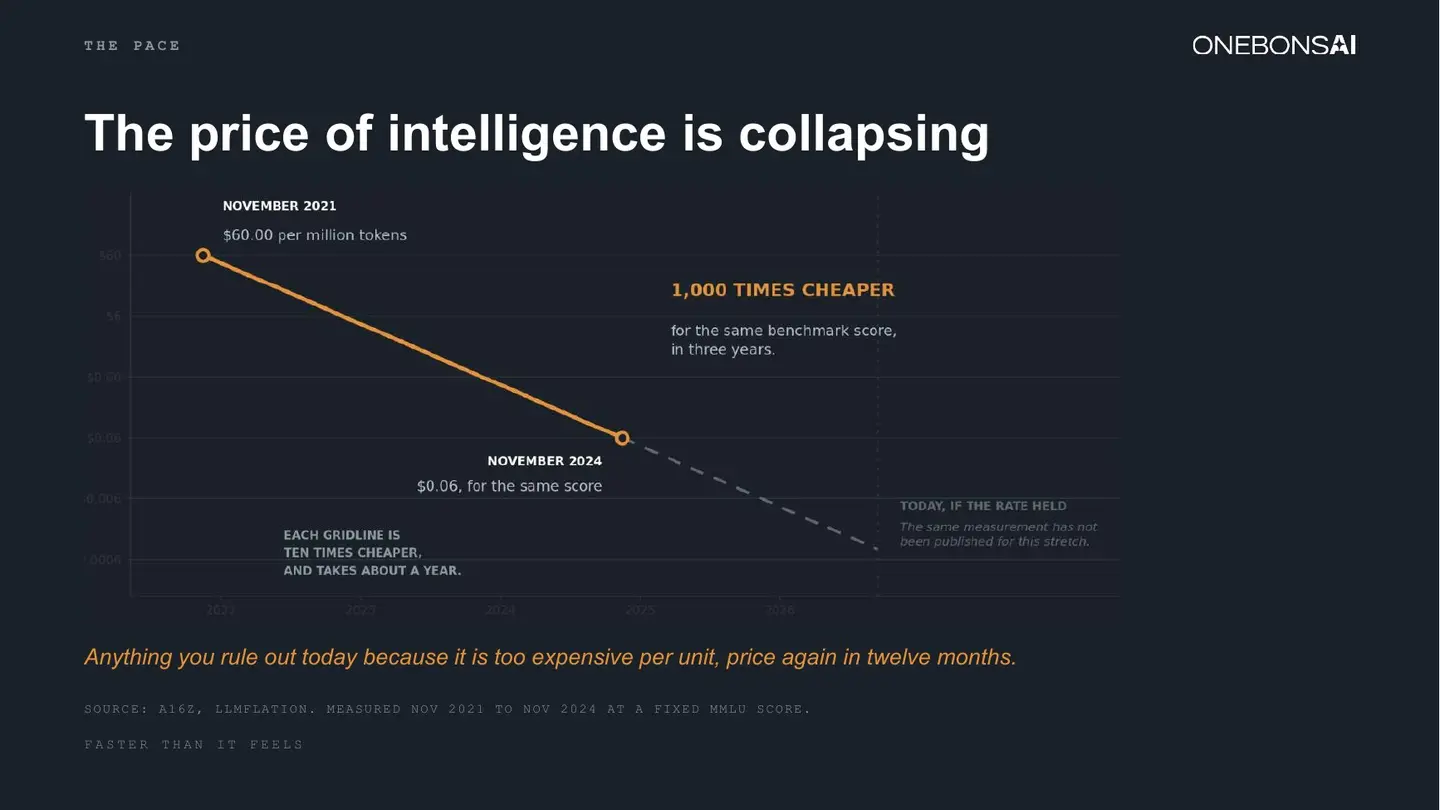
a16z measured what it costs to reach the same benchmark score over time. In November 2021 it cost 0.06. That is a thousand times cheaper in three years, or roughly ten times cheaper every year.
The practical lesson: anything you rule out today because it is too expensive per unit, price again in twelve months.
The price fell, but the bill went up
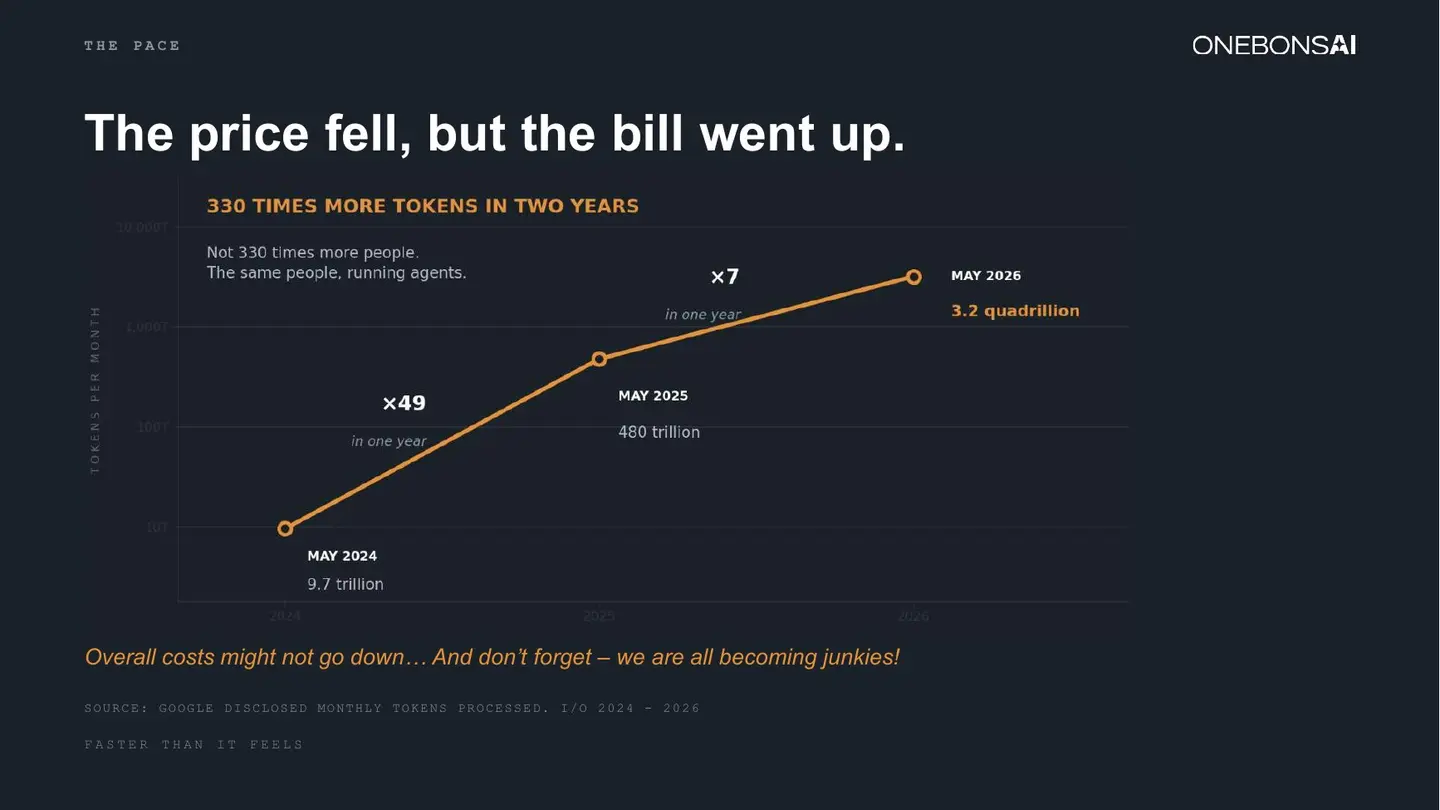
There is a catch. Google's disclosed figures show 9.7 trillion tokens processed per month in May 2024, 480 trillion in May 2025 and 3.2 quadrillion in May 2026. That is 330 times more tokens in two years. Not 330 times more people: the same people, running agents.
Cheaper per unit does not mean a smaller bill. Overall costs may not go down at all, because once a tool is useful, we all use a lot more of it.
Why none of it feels fast
Technology moves at the speed of research. Organisations move at the speed of five slower things.
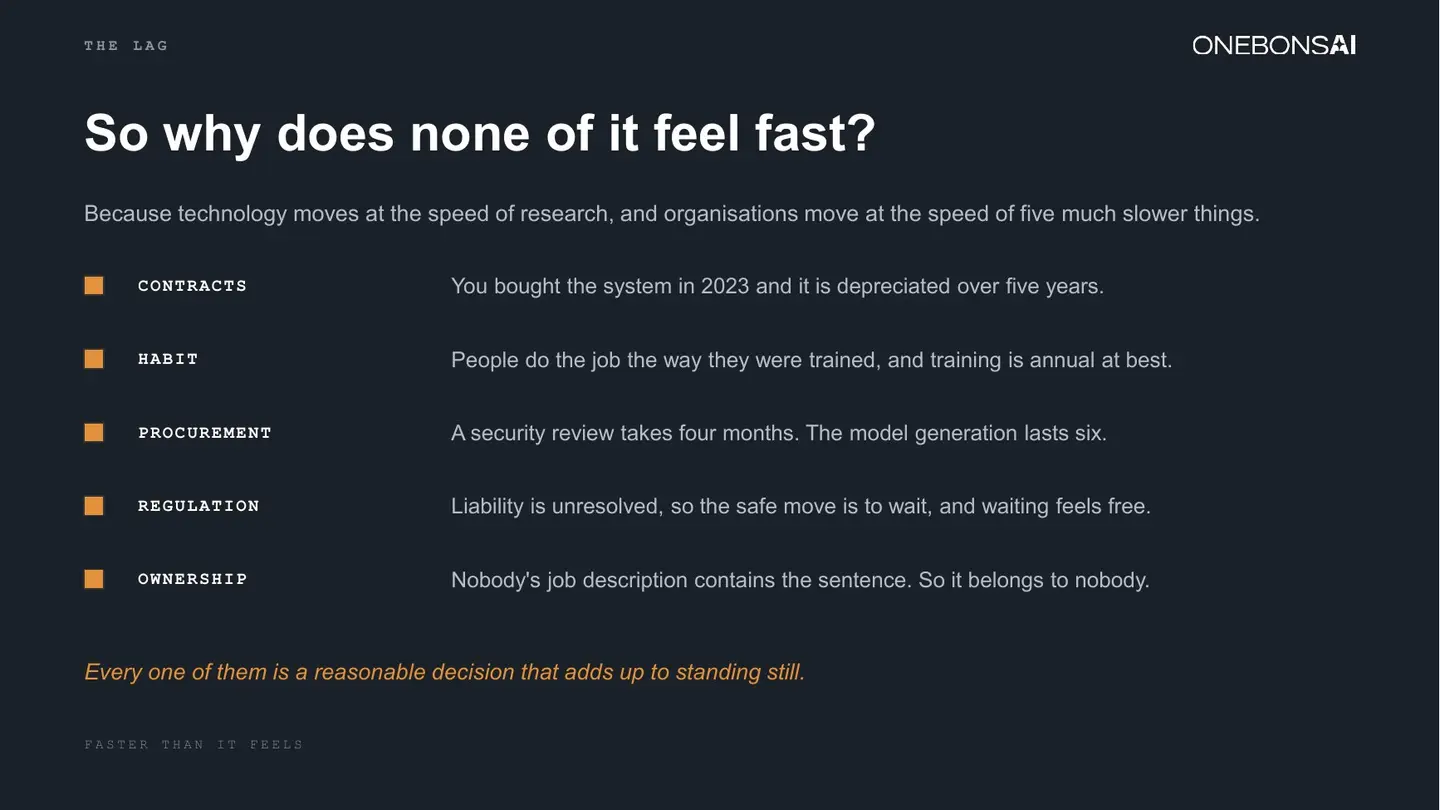
- Contracts. The system was bought in 2023 and is depreciated over five years.
- Habit. People do the job the way they were trained, and training happens once a year at best.
- Procurement. A security review takes four months. A model generation lasts six.
- Regulation. Liability is unresolved, so the safe move is to wait, and waiting feels free.
- Ownership. Nobody's job description mentions it, so it belongs to nobody.
Each of these is a reasonable decision. Together they add up to standing still.
You cannot see an exponential curve while you are on it
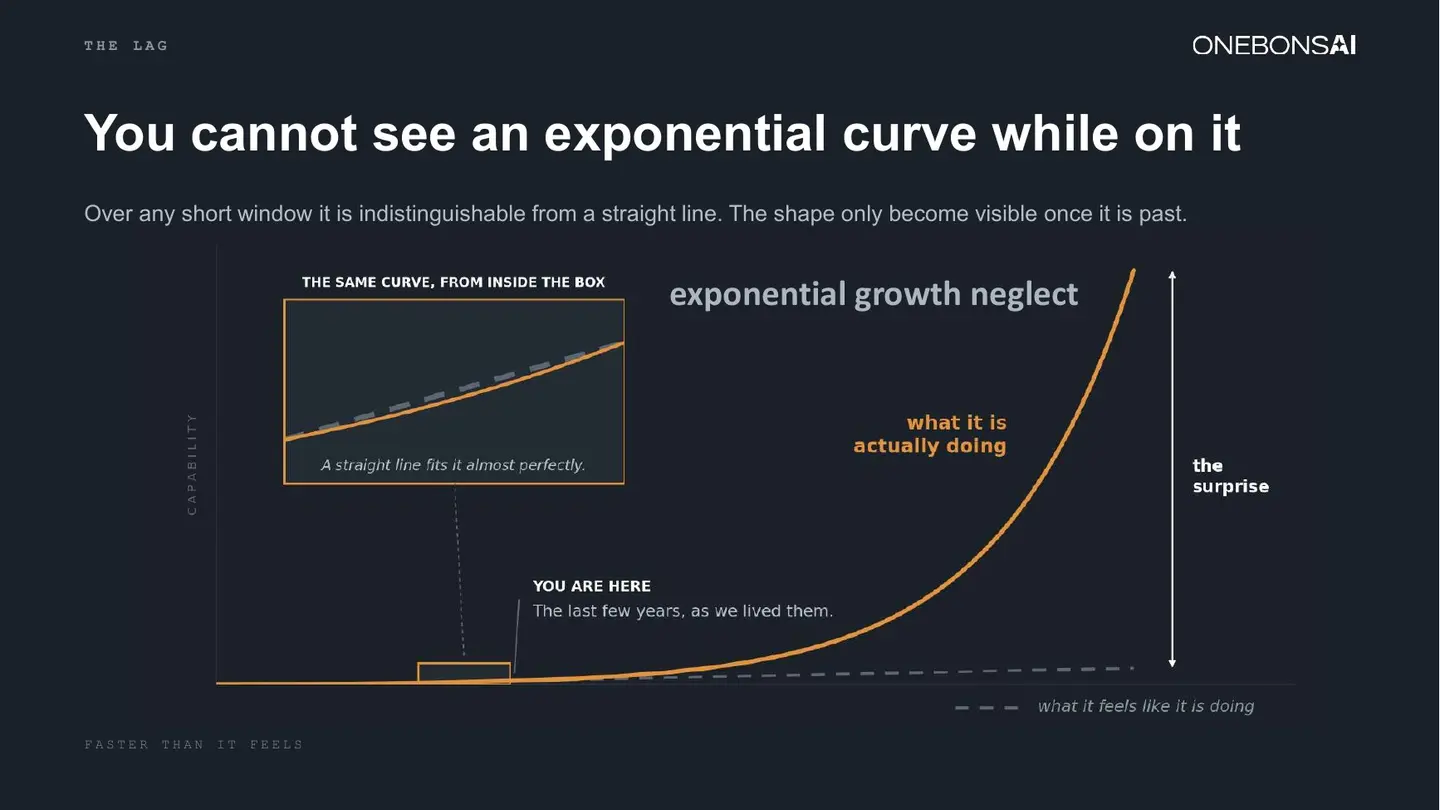
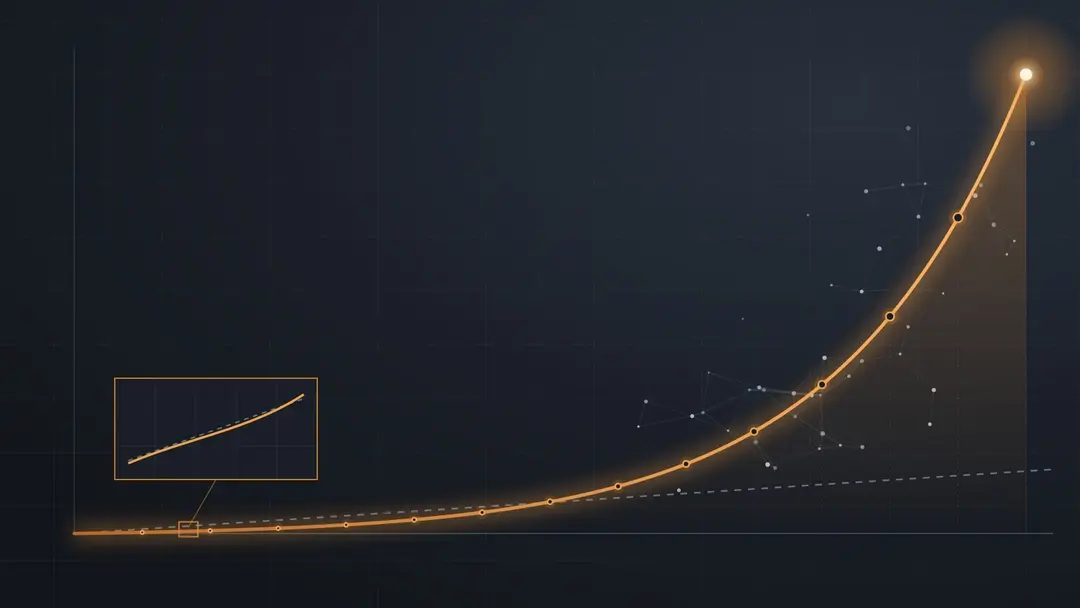
Over any short window, an exponential curve is almost indistinguishable from a straight line. The last few years, as we lived them, fit a straight line almost perfectly. The shape only becomes visible once you are past it. Psychologists call this exponential growth neglect, and it is why the pace feels manageable right up to the moment it does not.
Why the gap favours smaller companies
A large company has long procurement, a works council and a global rollout. Twelve months from decision to production, and the decision itself takes nine. A company with one owner or a small management team can choose one process, decide in an afternoon and be in production before the large company's security review is finished.
In this cycle, being small is an advantage, for about as long as the large companies take to finish deciding.
Shift one: language became the interface
Until recently, using business software meant menus, forms, dropdowns, a manual and two days of training. The user learned the software. Now the input is a sentence, in whatever language your people speak, and unstructured data counts as input too.
The consequence is not a nicer screen. People who never opened the ERP can now ask it questions, and the few who did no longer have to be the bottleneck.
The model is the commodity part. Four other things are the project, and they are why it takes months rather than a weekend:
- Retrieval. The assistant has to read your documents, catalogue and history, kept structured, current and permissioned.
- Tools. Answering is not enough. It needs defined actions it may take in your systems, with arguments you control.
- Permissions. Who may ask what. The assistant must not become a way around your access model.
- Audit. What it did, on what basis, and who to ask. Without this it never passes a serious review.
Swap the model for a better one next year and all four survive. Build them badly and no model will save you.
We run this ourselves. One system matches thousands of low-information tender line items against a product catalogue, with a confidence score on every match. Building the model took weeks. The project only became valuable once somebody agreed on a confidence threshold above which nothing gets re-checked. We also run a multi-agent system for our own work, marketing included, with defined tools, profiles and guardrails, on our own infrastructure. Being our own first customer is the fastest way to find out what breaks.
Shift two: from talking head to digital colleague
Avatars were a demo for a decade. Three things changed at once:
- It answers in real time. Latency dropped below the point where a conversation feels like a conversation rather than a form.
- It speaks every language you sell in. One trained persona, many languages, and the tenth language costs almost nothing.
- It can act, not only talk. Connected to your systems, it can look something up, book something or escalate something.
We introduced Jack, the AI-driven patient we built for medical training, who answers in his own words, shows emotion and can be configured with different illnesses and wounds. We wrote more about him in Digital Patients: Practising Clinical Conversations With AI.
Three jobs a digital worker can actually hold today:
- Sales. Product questions answered at any hour, in the customer's language, using only the price list it is allowed to see.
- Support. First line handled from your own manuals. When it escalates, it hands a person the full context instead of a ticket number.
- Training. The same instructor for every shift, site and language, so onboarding no longer depends on who was free that week.
The face is no longer the hard part. The hard part is what it is allowed to say, and to whom. Where it goes wrong is when companies buy the avatar and skip the content. A digital worker with nothing reliable to read is a very expensive way to say "I am not sure" in nine languages.
Shift three: the model moved into the building
Two years ago, running a model on-premise meant accepting a worse model. That is no longer the trade. The hardware got small enough: a single workstation card or an Apple Silicon machine with enough unified memory runs serious models. Open-weight models now trail the frontier by roughly three to six months instead of years. And the reasons to do it multiplied: data residency, latency, cost at volume, and customers who will not sign unless the data stays put.
The question stopped being whether you can run it yourself. It is whether you should.
Run it locally when your data is regulated, personal or contractually bound; the workload is high-volume and repetitive; latency matters, or an agent makes thirty calls per task; you want to fine-tune on your own material; or a customer will not sign if data leaves the building.
Use the cloud when you need the very best reasoning available today; the work is multimodal or genuinely hard; volume is low or unpredictable; you have no appetite for running infrastructure; or you want new capability the week it ships.
Most companies end up with both, and that is the right answer rather than a failure to decide. Route the sensitive and the repetitive to your own hardware, send the rare and the difficult out, and keep the ability to switch.
The economics, honestly
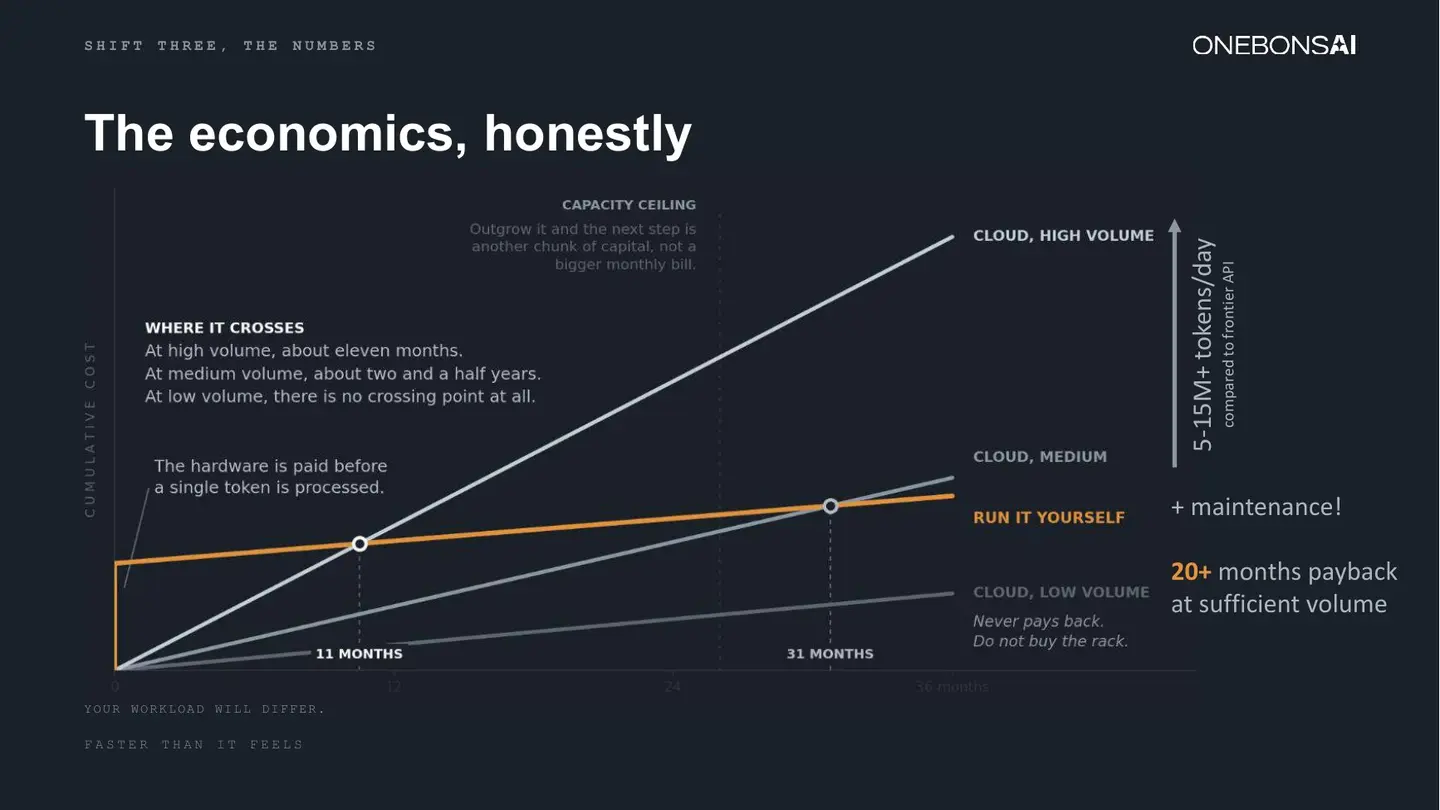
Running a model yourself starts with a step: the hardware is paid before a single token is processed. After that, the cost line is fairly flat. The cloud starts at zero and grows with every token. Where the lines cross depends entirely on your volume:
- High volume: after about eleven months.
- Medium volume: after about two and a half years.
- Low volume: never. Do not buy the rack.
Measured against a frontier API, the threshold is somewhere around 5 to 15 million tokens a day or more, and at sufficient volume you should still expect a payback of 20 months or longer. Add maintenance on top. And there is a capacity ceiling: outgrow the box and the next step is another chunk of capital, not a slightly bigger monthly bill.
The comparison above is with frontier API prices. Compare like with like and the picture changes.
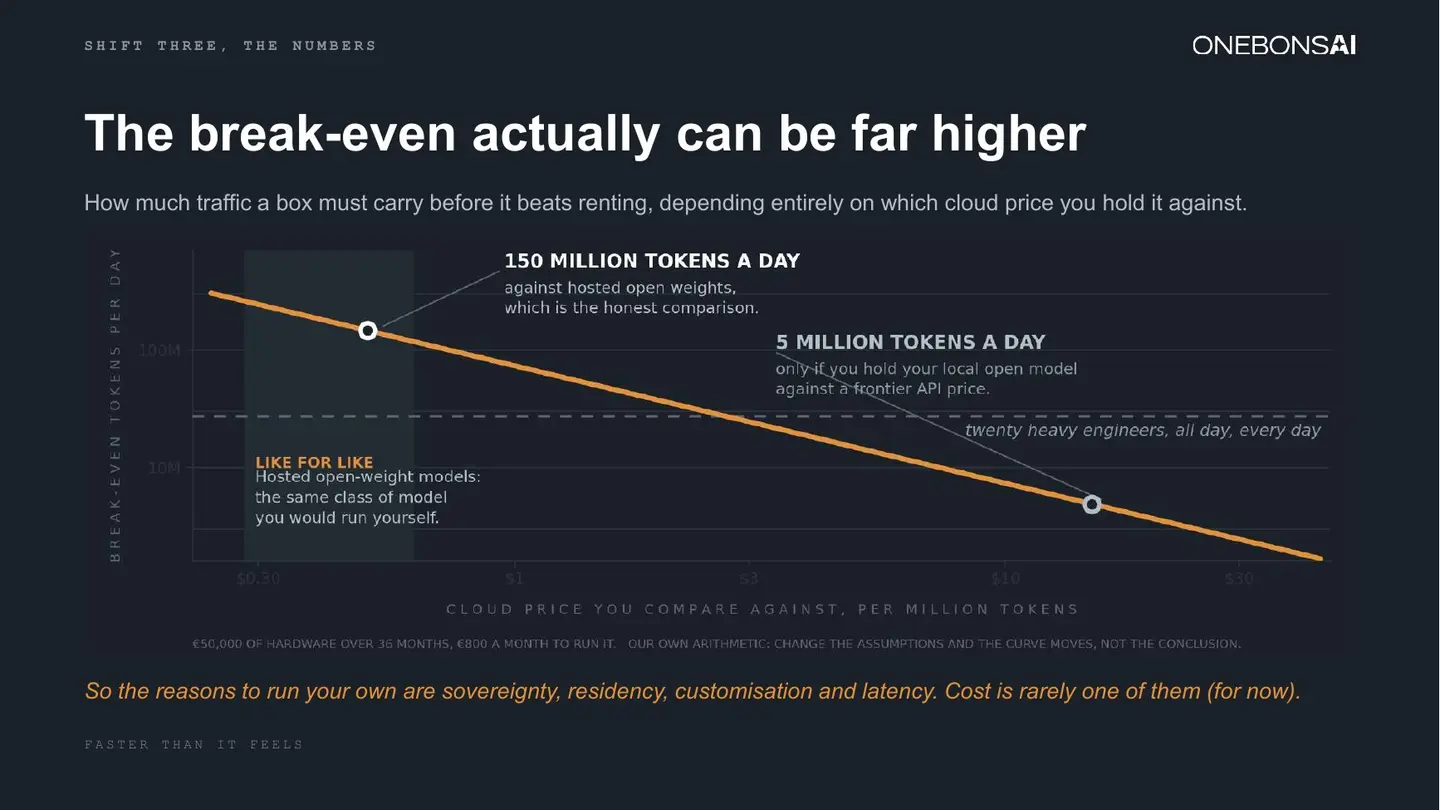
Take €50,000 of hardware over 36 months and €800 a month to run it. Against a frontier API price, the box pays for itself at around 5 million tokens a day. Against hosted open-weight models, the same class of model you would run yourself, the break-even is closer to 150 million tokens a day. Change the assumptions and the curve moves, but the conclusion does not: the reasons to run your own are sovereignty, residency, customisation and latency. For now, cost is rarely one of them.
And there are four downsides that never go away:
- Maintenance. Somebody has to patch it, monitor it and get up when it stops. If nobody wants that job, the cheap option on paper is the expensive one in practice. This one kills more projects than the other three together.
- The money is up front. Hardware is capital, spent before the first token. A cloud bill starts at zero, which is far easier to defend to a board.
- Never quite as good. On the hardest reasoning the gap with the best cloud models is wider than three to six months, and some work cannot be done locally at all.
- Scaling is lumpy. You cannot buy ten percent more capacity. Demand grows smoothly, capacity grows in steps.
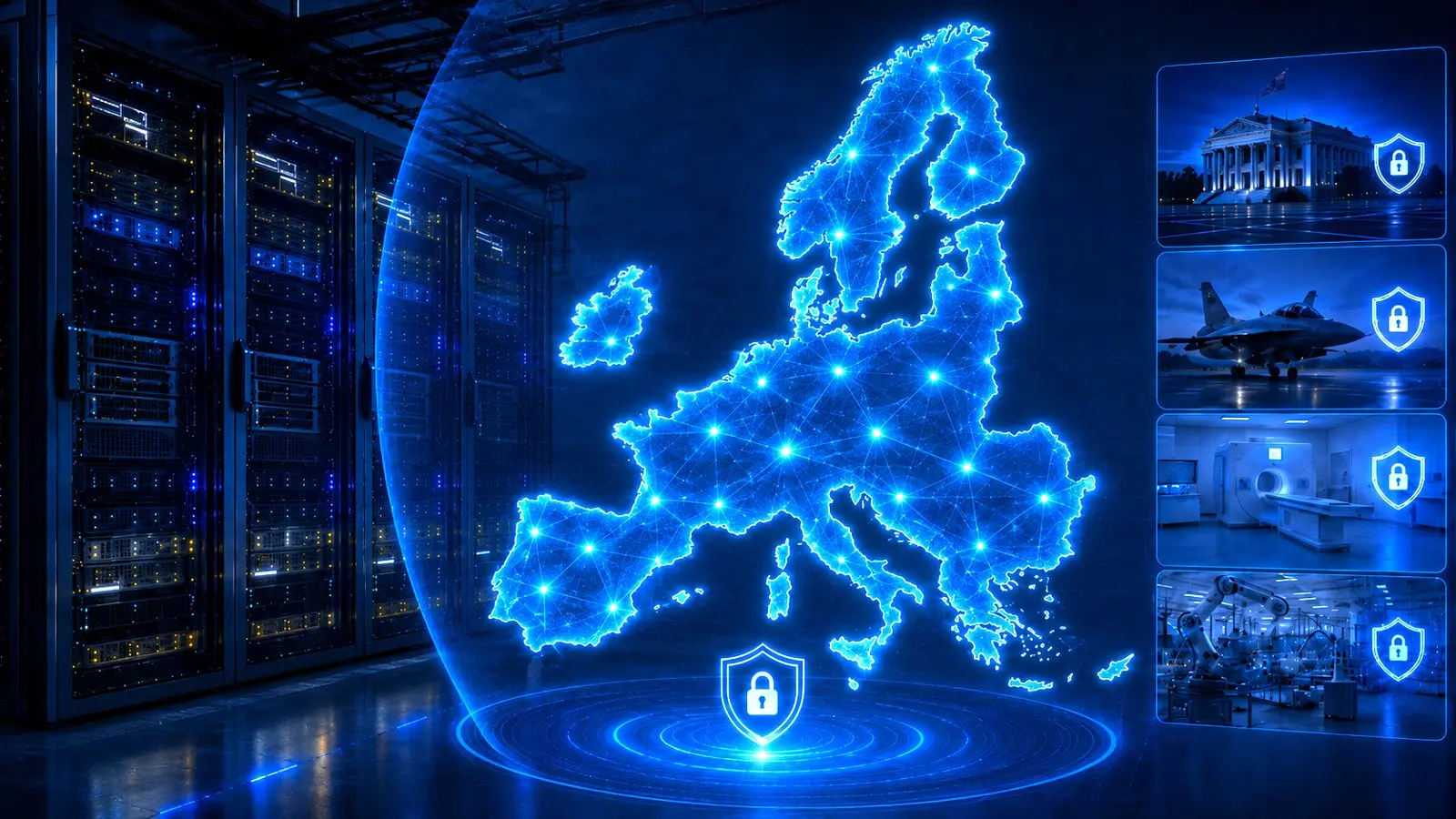
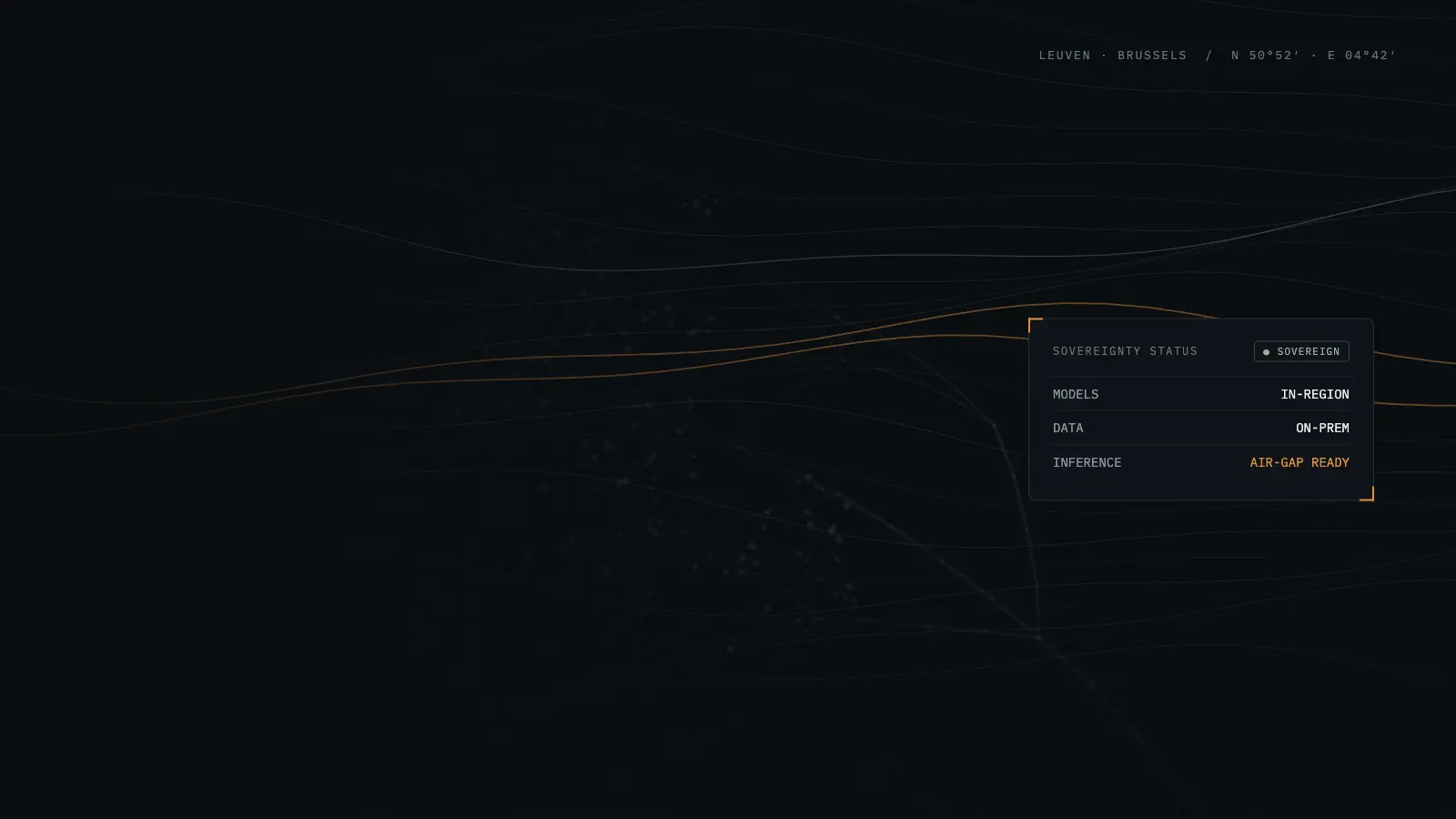
We took our own advice. Our AI platform runs in our own building, on four L40S cards with virtualised GPUs and a Mac Studio with around 250 GB of unified memory for the larger models, on top of the ordinary pieces any company needs: virtualisation, storage, single sign-on. It does not equal the best cloud models, and for the hardest work we still go out. Knowing exactly where that line sits is the point. If a company our size can do this, capability is not your obstacle. Whether the workload justifies it is the real question. For more on this, see what EU AI sovereignty actually requires and our AI infrastructure page.
Shift four: AI left the screen
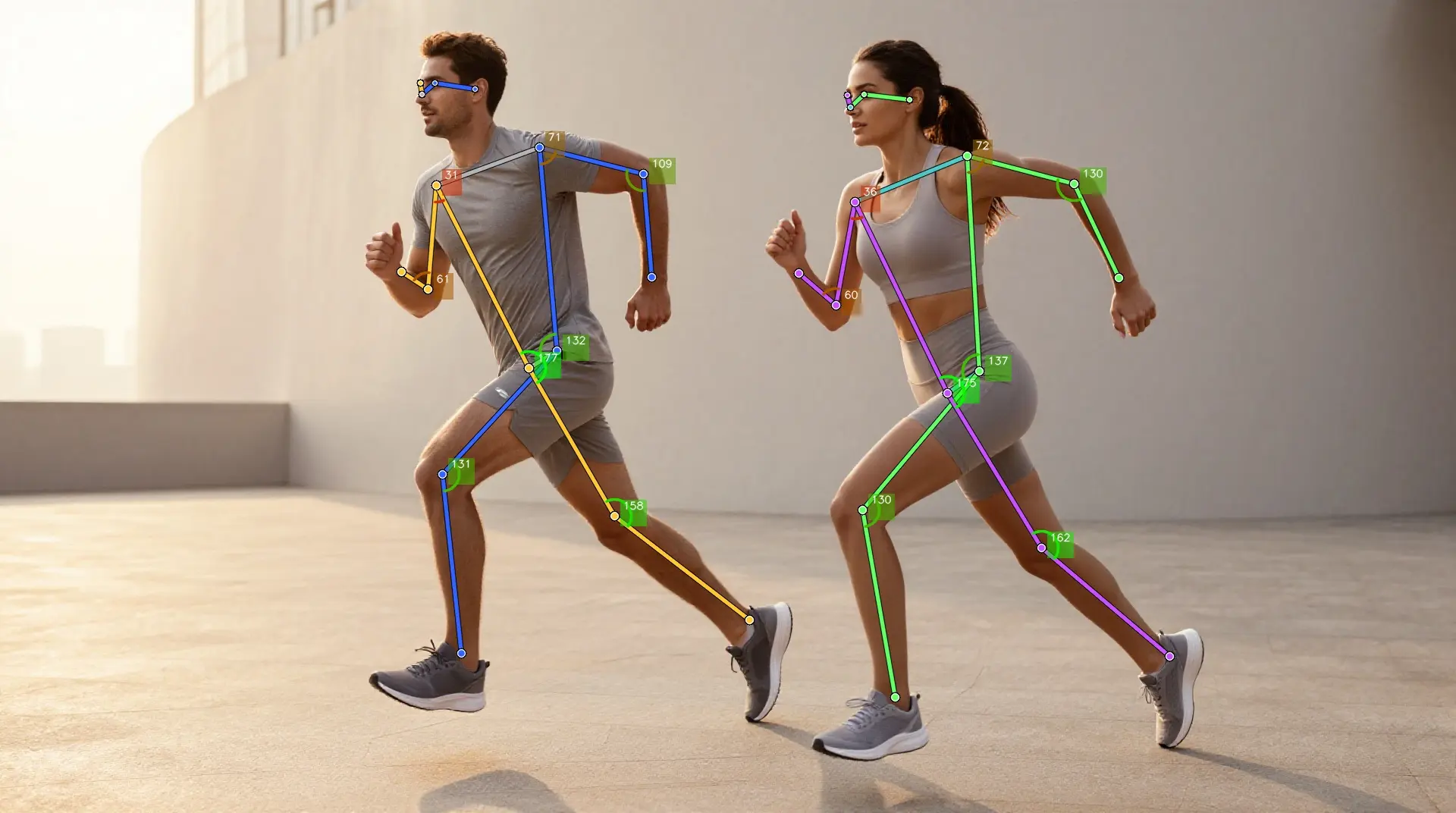
The same models that read your documents now interpret camera feeds, drive machines and rehearse in simulation before touching anything real. Four capabilities come together:
- Perception. Cameras and sensors that judge a scene the way a trained operator would, and say why.
- Mobility. Machines that go where sending a person is the wrong answer, or simply the expensive one.
- Simulation. Digital twins that rehearse a scenario thousands of times before the real one happens once.
- Authority. A person in the loop on every decision with physical consequences. Not optional.
In software, a mistake is a wrong answer. In the physical world, a mistake has a cost, and that changes how the system must be built.
What is running, and what is still a promise
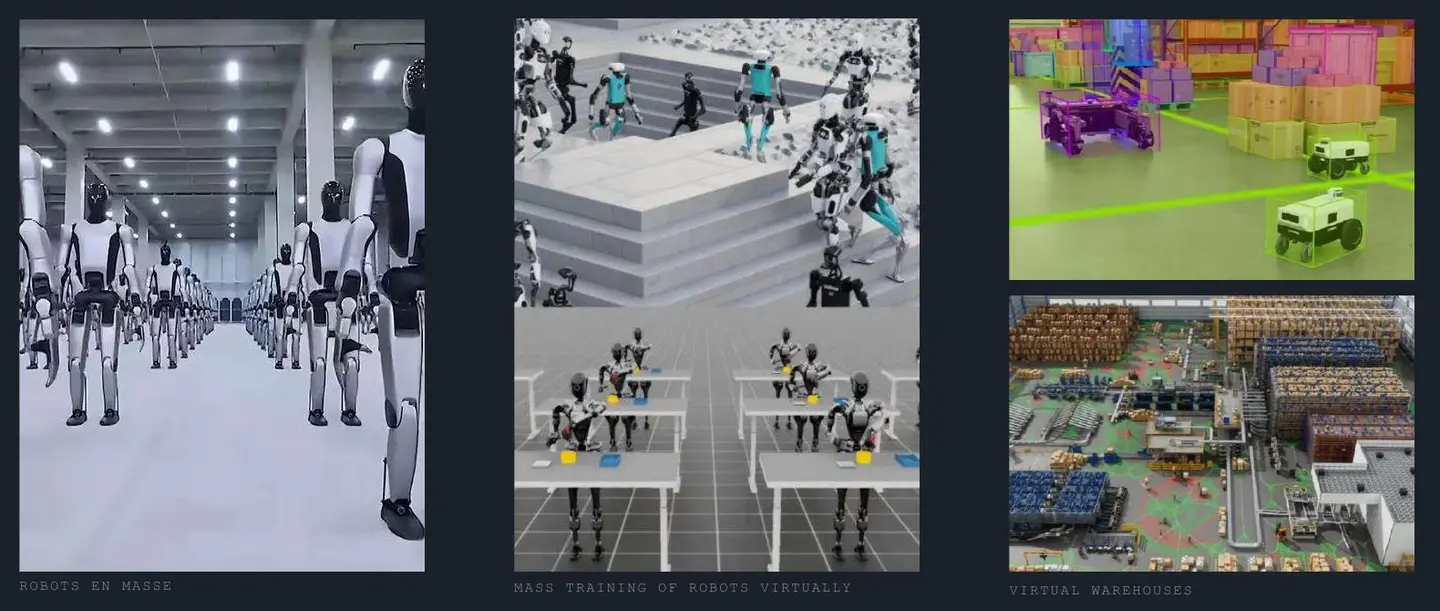
Robots are being built in numbers, trained by the thousand in simulation, and tested in virtual warehouses before anything moves in a real one.
Running today: over a million robots in one retailer's warehouses, millions of paid driverless taxi rides, commercial driverless freight, autonomous drone inspection of bridges and roads, and imaging systems that position themselves in hospitals. Still a promise: general-purpose humanoids doing varied physical work, robots that cope with a site they have never seen, closing the gap between simulation and the messy real world without help, and mass adoption, which credible projections place in the 2030s.
The bodies stopped being the bottleneck. Judgement is the bottleneck now.
Vision AI is the cheapest way in
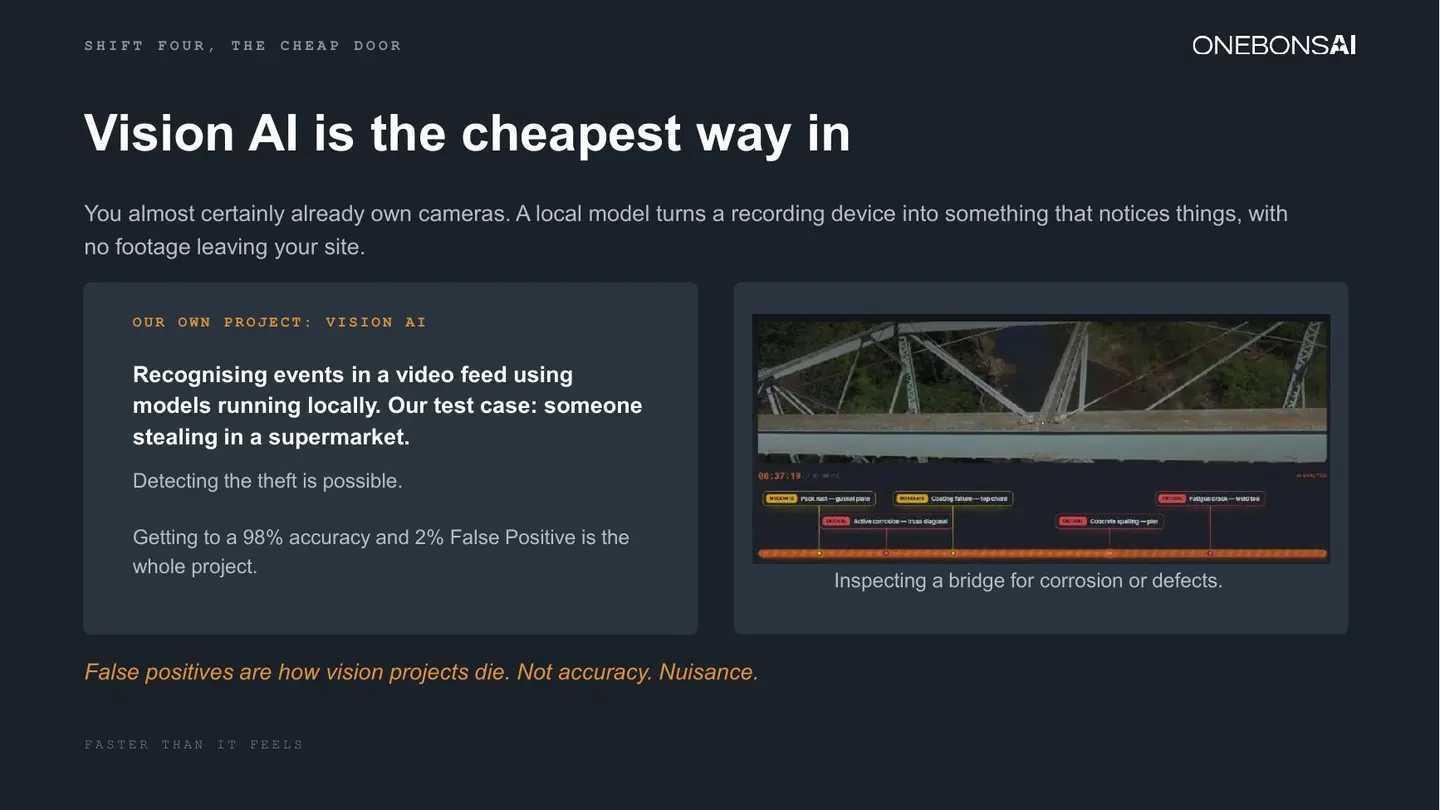
You almost certainly already own cameras. A local model turns a recording device into something that notices things, with no footage leaving your site. Our own test case was recognising theft in a supermarket. Detecting it is possible. Getting to 98% accuracy with a 2% false positive rate is the whole project. The same approach applies to inspecting a bridge for corrosion or defects. Vision projects rarely die on accuracy. They die on nuisance.
Across industry, logistics and care, the winning projects share one thread: they replaced a judgement that was expensive to buy consistently, not a task that was expensive to perform.
Where we build in the physical world
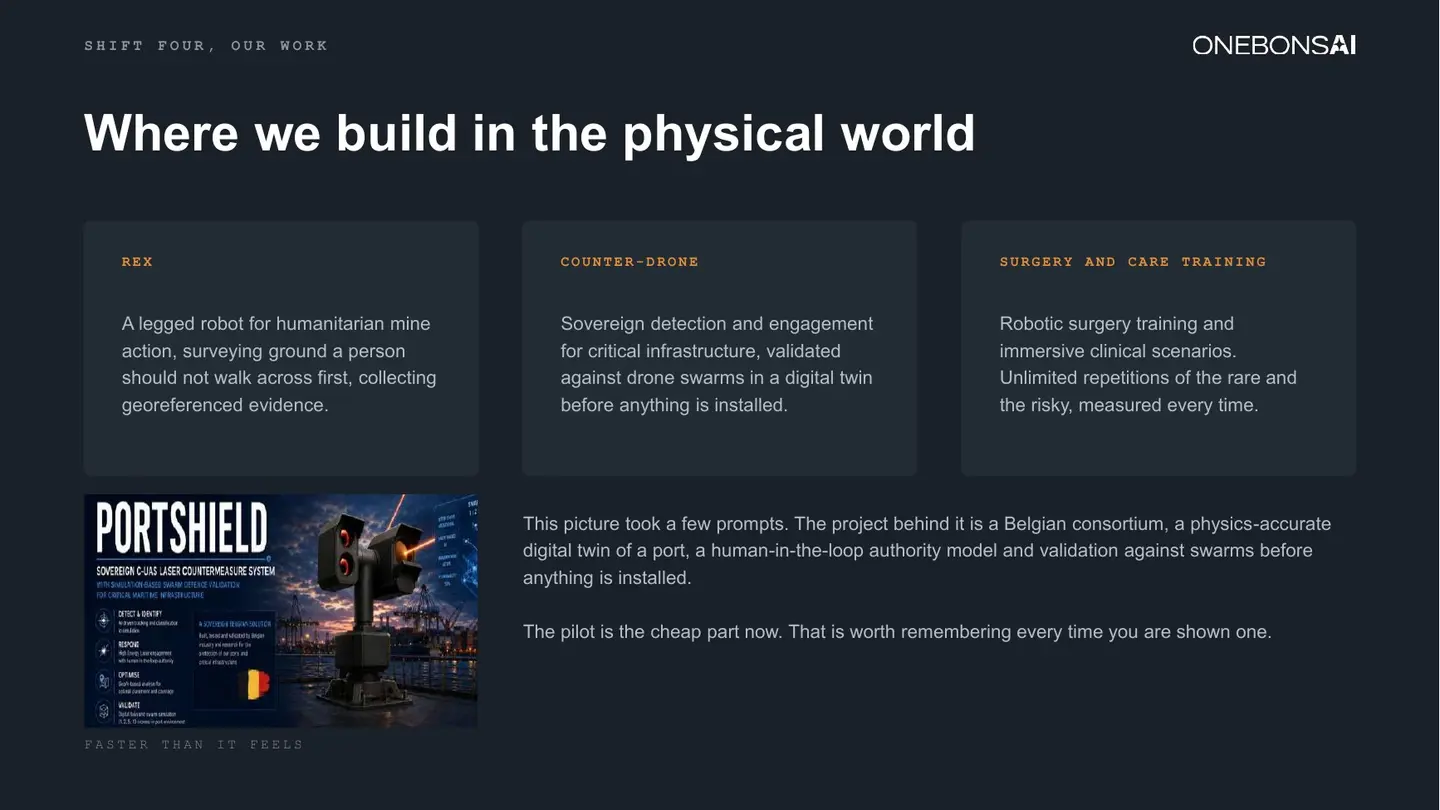
- REX. A legged robot for humanitarian mine action that surveys ground a person should not walk across first, collecting georeferenced evidence.
- Counter-drone. Sovereign detection and engagement for critical infrastructure, validated against drone swarms in a digital twin before anything is installed.
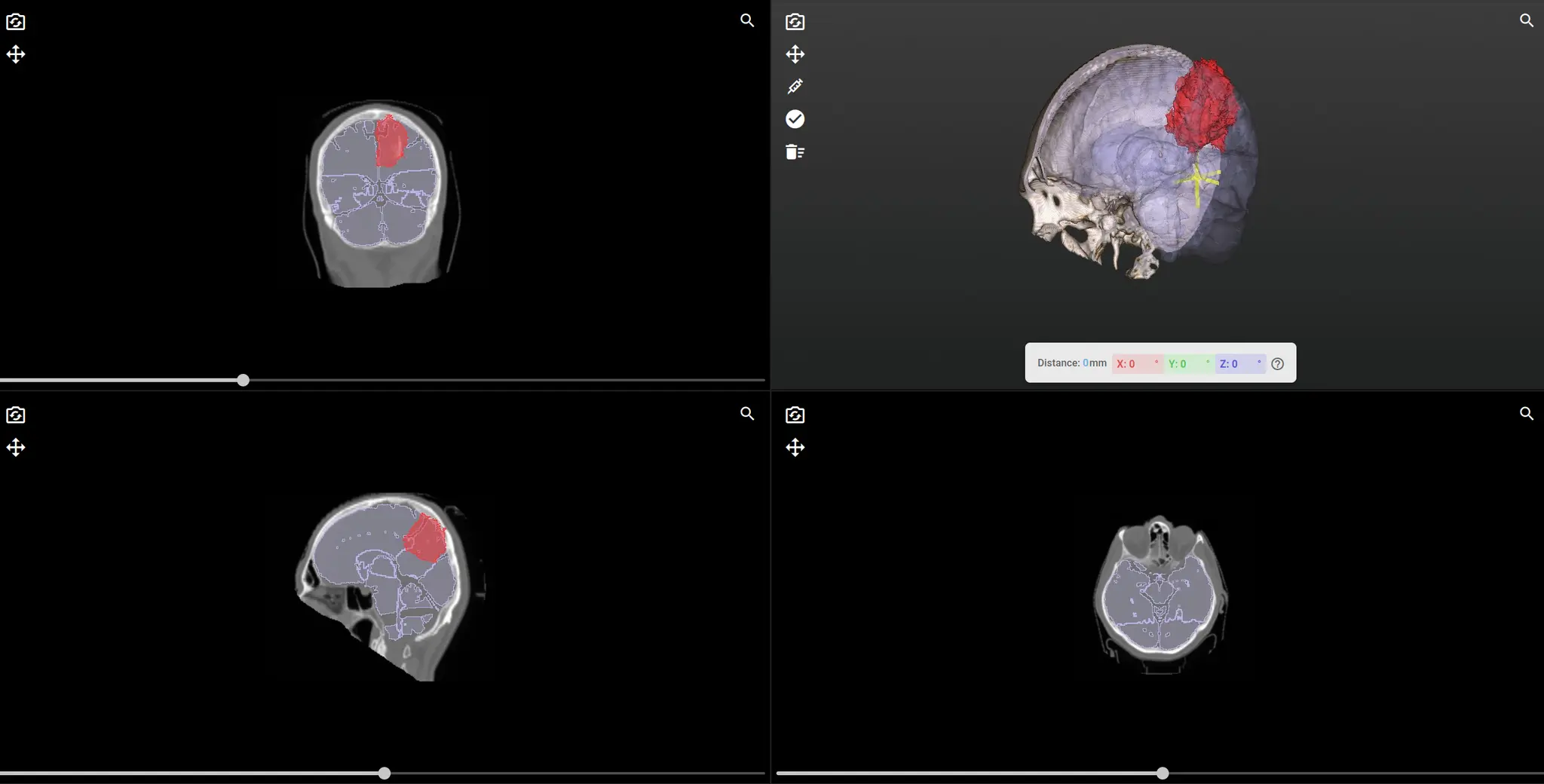
- Surgery and care training. Robotic surgery training and immersive clinical scenarios, with unlimited repetitions of the rare and the risky, measured every time.
The PortShield picture on that slide took a few prompts. The project behind it is a Belgian consortium, a physics-accurate digital twin of a port, a human-in-the-loop authority model and validation against swarms before anything is installed. The pilot is the cheap part now. Remember that every time someone shows you one.
The next five years
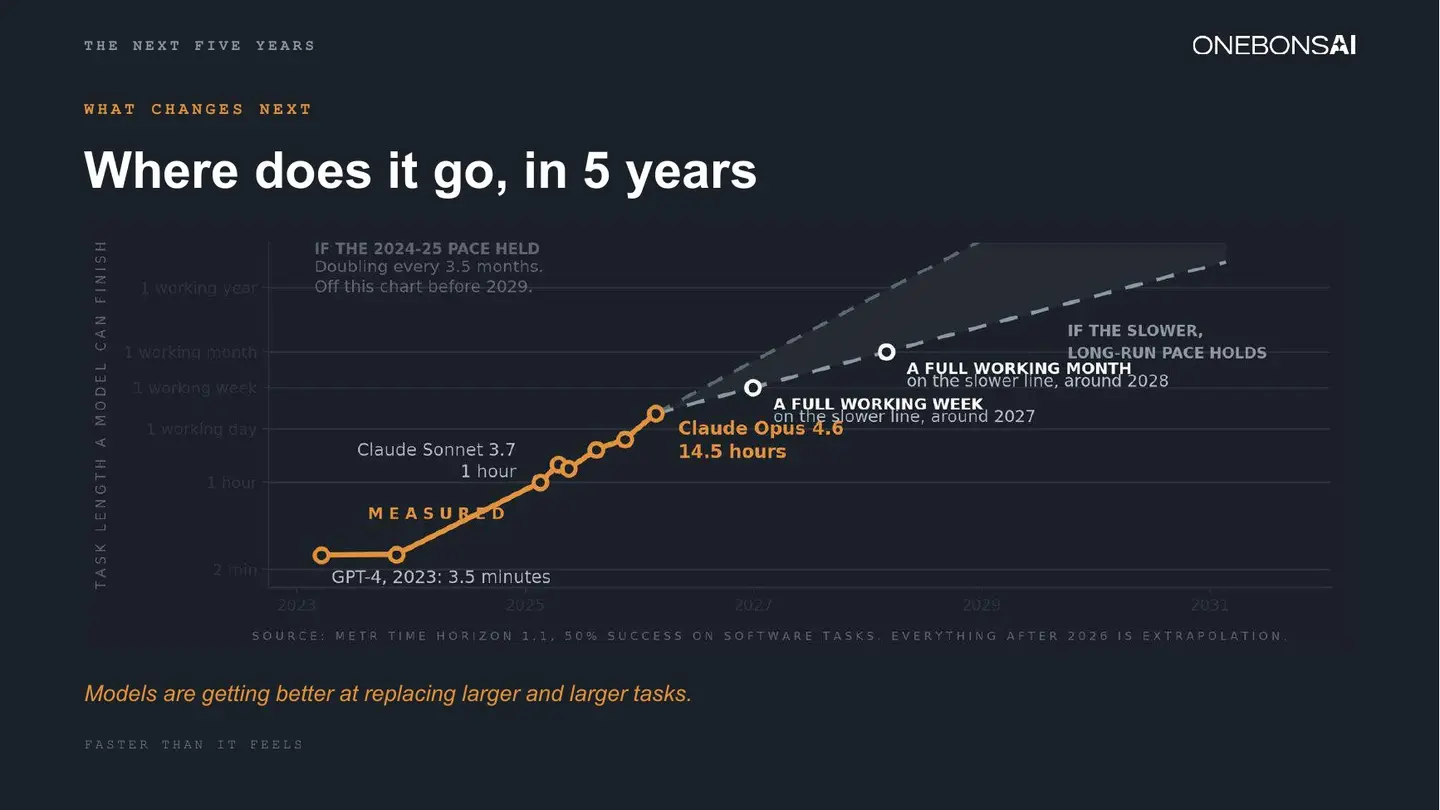
METR measures how long a software task can be before a model completes it half the time. In 2023, GPT-4 managed tasks of about 3.5 minutes. Claude Sonnet 3.7 reached about an hour. Claude Opus 4.6 reached about 14.5 hours.
Everything after 2026 is extrapolation, and the chart shows two lines. If the 2024–25 pace held, with task length doubling every 3.5 months, it runs off the chart before 2029. On the slower, long-run pace, models handle a full working week of work around 2027 and a full working month around 2028.
You do not need to believe either line exactly. The direction is enough: models are getting better at taking over larger and larger tasks, not only answering questions.
What it looks like in your sector
We went through the sectors in the room:
- Manufacturing and materials. Formulation and specification history becomes searchable. Visual inspection on the line. Simulate a changeover before committing to it.
- Construction and fit-out. Site photos become a record you can query. Quantities and quotes drafted from drawings. Progress checked from the camera, not the report.
- Logistics and real estate. Warehouse robotics at a price that finally works below enterprise scale. Yard and dock monitoring from cameras you already installed.
- Energy and metering. Anomaly detection on data you already collect. The advantage is not the model, it is the fifteen years of readings you already own.
- Accountancy and finance. Coding an invoice was never in doubt. The project is deciding which categories post without a human, and who signs that list.
- Agencies and services. Every proposal you ever sent, marked won or lost, is the best training set your business will ever have. It is sitting in a mailbox.
- Signage, print and fabrication. Quotes drafted from a customer drawing, visual quality control, and a decision on the value below which a quote goes out unread.
- ERP and software services. Your clients will ask for an assistant that writes to records, not one that suggests. The deliverable is the field list and the rollback.
How to start: score one of your own processes
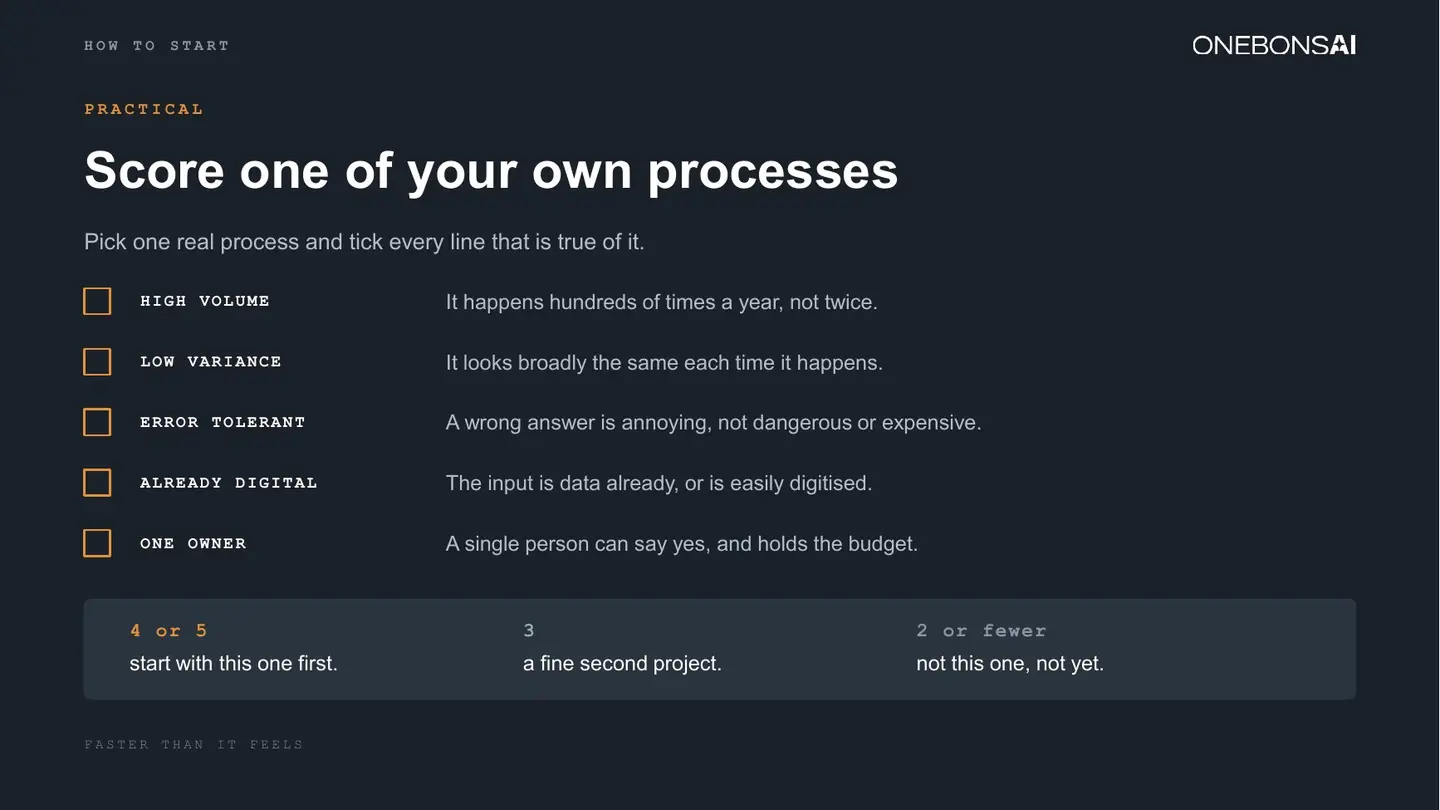
Pick one real process and tick every line that is true of it:
- High volume. It happens hundreds of times a year, not twice.
- Low variance. It looks broadly the same each time it happens.
- Error tolerant. A wrong answer is annoying, not dangerous or expensive.
- Already digital. The input is data already, or is easily digitised.
- One owner. A single person can say yes, and holds the budget.
| Ticks | Verdict |
|---|---|
| 4 or 5 | Start with this one first. |
| 3 | A fine second project. |
| 2 or fewer | Not this one, not yet. |
Then, before you fund anything, answer three questions:
- Which decision changes, and who owns it afterwards? If the answer is nobody, you are buying a second opinion.
- What do we know that nobody can buy, and can a machine read it? If it cannot, that is the project, and it is not an AI project.
- What happens on a bad day, and who is accountable? If that has not been discussed, you have a pilot, not a system.
If you cannot answer all three, you do not have a project. You have an experiment, which is fine, as long as everybody calls it one.
Thank you, and let's talk
Thanks to Voka Vlaams-Brabant for hosting with us, and to everyone who came and shared what is actually stuck in their operations. An hour of that is worth more than a month of market research.
If you want to discuss a process, find out whether AI fits it, or look for a partner to build it, contact us at [email protected].
References
- [1]a16z, "Welcome to LLMflation": LLM inference cost at a fixed MMLU score, November 2021 to November 2024
- [2]Google I/O 2024 to 2026: disclosed monthly tokens processed
- [3]METR, Time Horizon 1.1: task length at 50% success on software tasks
- [4]Deloitte, Tech Trends 2026
- [5]McKinsey, The State of AI 2026